As Russia’s full-scale invasion of Ukraine progressed, Russian war commentators and other prominent voices covering the war faced an ever-growing stream of battlefield developments to address. Retreats, personnel and equipment losses, failed operations, and command errors increasingly became subjects of public debate. But these setbacks were far from universally acknowledged, and commentators approached them in markedly different ways. Some denied failures or sought to justify them. Others shifted the blame, voiced criticism through the opinions of others, or openly questioned decisions made by the military leadership. What matters is not just what they say about the war, but how they interpret events, whom they hold responsible, and which issues they choose to leave unaddressed.
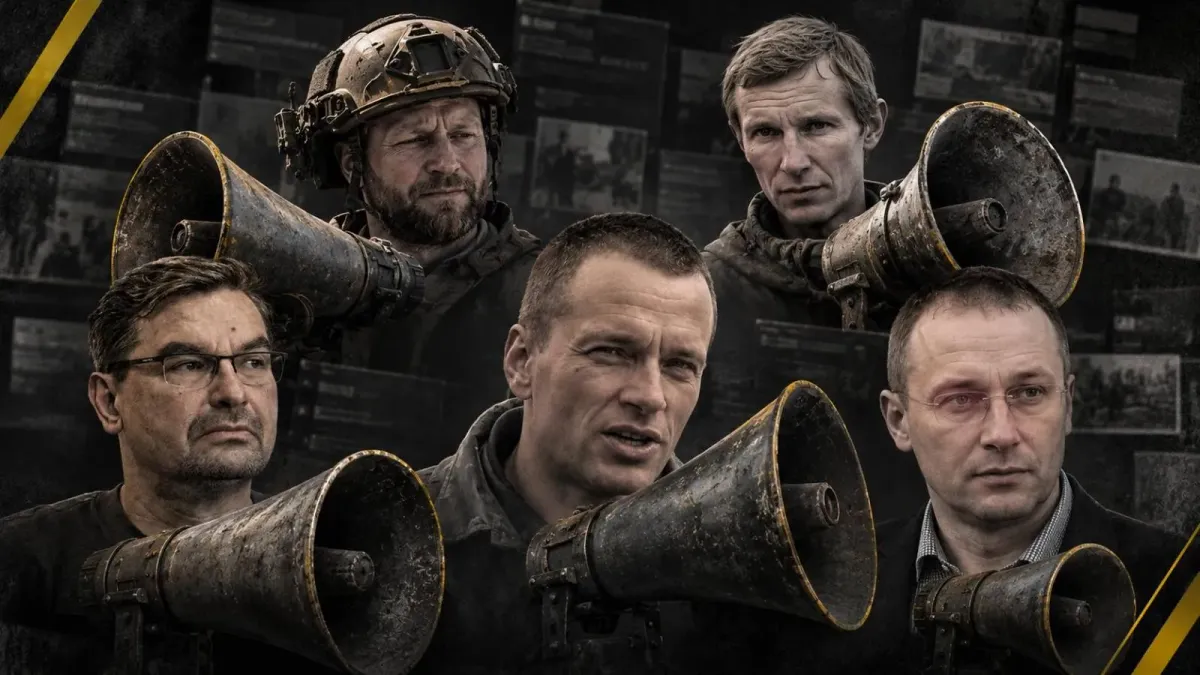
Throughout this article, the term “Russian war commentators” is used in a broad sense. It includes not only journalists reporting from the front lines, but also public figures who regularly comment on Russia’s war against Ukraine, assess battlefield developments and military decisions, and shape how their audiences perceive the conflict. The analysis focuses on five such commentators: Nikolai Dolgachev, Alexander Yegortsev, Vladimir Vorsobin, the author of the Fighterbomber Telegram channel, and Mikhail Onufrienko. They represent different segments of Russia’s war commentary sphere, including television correspondents, a radio commentator, a Telegram channel author, and a military-political pundit.
The analysis looks at how these figures discuss Russian military losses and setbacks, whether they acknowledge problems within the armed forces, how they assess decisions made by commanders, and where they place responsibility. Particular attention is paid to how criticism is conveyed: through direct statements, references to other people’s assessments, reposts, or rhetorical questions that allow a critical point to be raised without explicitly endorsing it. The five commentators are considered along a spectrum, from those who are most reluctant to acknowledge military failures to those who speak more openly about military miscalculations and decisions made by the military leadership. The focus is exclusively on their public statements, without drawing conclusions about their private beliefs.
A recurring pattern emerges from the examples examined: criticism is generally directed at how Russia is waging the war, rather than why it launched the invasion. These commentators may expose failed operations, criticise command decisions, acknowledge casualties, call for a change in strategy, or hold individual officials responsible. Yet such criticism does not necessarily challenge the objectives of the invasion, Russia’s responsibility for starting the war, or the decision to continue it. Distinguishing between criticism of how the war is being fought and opposition to the war itself helps establish the limits of each commentator’s criticism.
This distinction is important when examining Russia’s information environment. Harsh criticism of military commanders, acknowledging battlefield losses, and frustration with the outcomes of military operations should not automatically be taken as signs of opposition to the invasion. Examining how commentators explain setbacks, assign blame, draw on other people’s statements, and avoid certain subjects provides a clearer understanding of the narratives they promote. It also helps readers identify attempts to shape perceptions of the war and distinguish criticism of Russia’s military performance from rejection of its aggression against Ukraine.
This approach also encourages readers to look beyond what is explicitly stated: to consider whose views are being presented, who is being held responsible, where criticism is directed and what is left unsaid. These skills are useful not only for analysing Russian wartime rhetoric, but also for understanding how propaganda, information campaigns and public narratives are constructed and communicated more broadly.
Dolgachev: The Enemy’s Failures, Russia’s Acceptable Losses
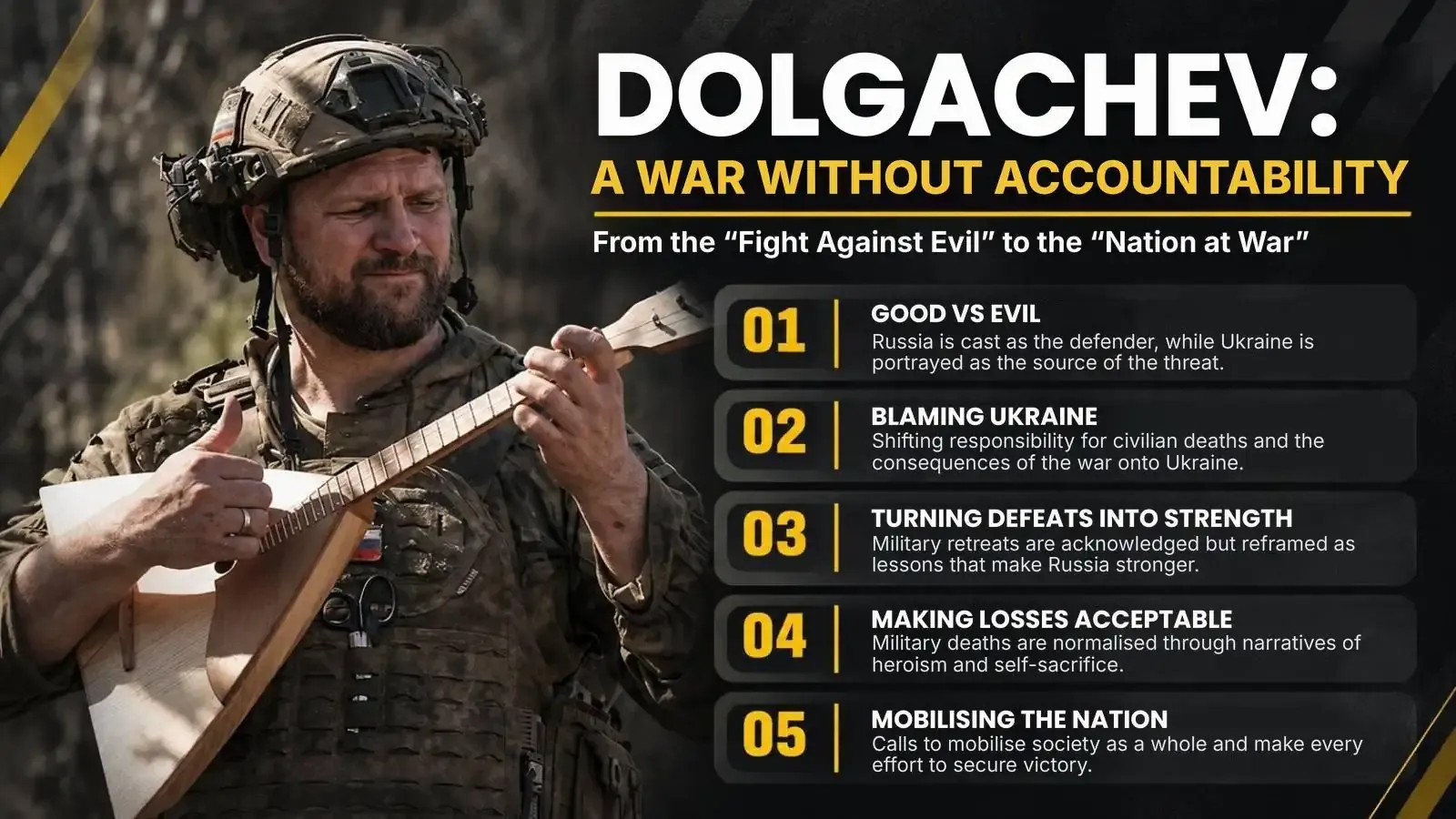
Nikolai Dolgachev is a war correspondent for VGTRK, Russia’s state broadcaster. He has lived and worked in Russian-occupied Luhansk since early 2022. In April 2014, he was appointed head of VGTRK’s Crimean bureau. He became a war correspondent in November 2014 and, in April 2016, headed the Public Council for the Construction of the Kerch Bridge. He currently runs VGTRK’s Luhansk branch and has hosted the programme Nashi on Russia-1 since August 2024. On 11 April 2025, Ukraine imposed sanctions on him. The Kremlin’s Mouthpieces database notes that his Telegram channel, DolgZ, justifies the actions of the Russian military. In December 2023, he joined the team supporting Putin’s presidential campaign, and on 22 February 2024, he endorsed an event honouring participants in the so-called “special military operation” (SVO), according to FedPress. The programme Nashi was also mentioned in OsintFlow’s article Children as Props in Propaganda (30 September 2026), which examined the formats war correspondents use to engage children in occupied territories.
Profile on Myrotvorets: an accomplice of terrorists and Russian occupiers, and an anti-Ukrainian propagandist. The profile states that, from 8 April 2014, he headed the Crimean bureau of the All-Russia State Television and Radio Broadcasting Company (VGTRK), and that from November 2014 he worked as a war correspondent, primarily in occupied Donetsk.
Dolgachev’s public rhetoric is built around a moral division between the two sides: Russia is portrayed as a defender, while Ukraine is presented as a source of violence and threat. This framing is already apparent in his posts from the first days of the full-scale invasion. On 5 March 2022, the tenth day of the invasion, at 12:32, he reported that positions held by “Right Sector” fighters and Ukrainian Armed Forces personnel in the so-called “LPR” had been destroyed, adding that they had not held out for long. At 12:42, he wrote that the people of Donbas had lived under a reign of terror for eight years. At 18:50, he showed a symbol that, according to him, “Right Sector” fighters had used at checkpoints near Trokhizbenka, adding that it answered the question of whom the war was being fought against. The post received 89,400 views. At 20:31, he wrote about the restoration of housing: Ukraine had destroyed it, the Republic was rebuilding it, and the question of who represented Good and who represented Evil was, in his words, rhetorical.
What matters in this sequence is not just the individual accusations, but how the argument is constructed. Russian military actions are presented as acts of protection and reconstruction, while Ukraine’s actions are portrayed as evidence of its supposedly criminal nature. This division leaves no room for a neutral assessment of events: Russia is automatically assigned the moral high ground, while its adversary is placed on the side of Evil. Dolgachev applies the same logic to reports of combat operations. For example, on 7 July 2023, at 22:07, he recounted a report about Russian assault troops who had killed several enemy fighters and taken five prisoners. In this framing, military successes become proof that his own side is in the right.
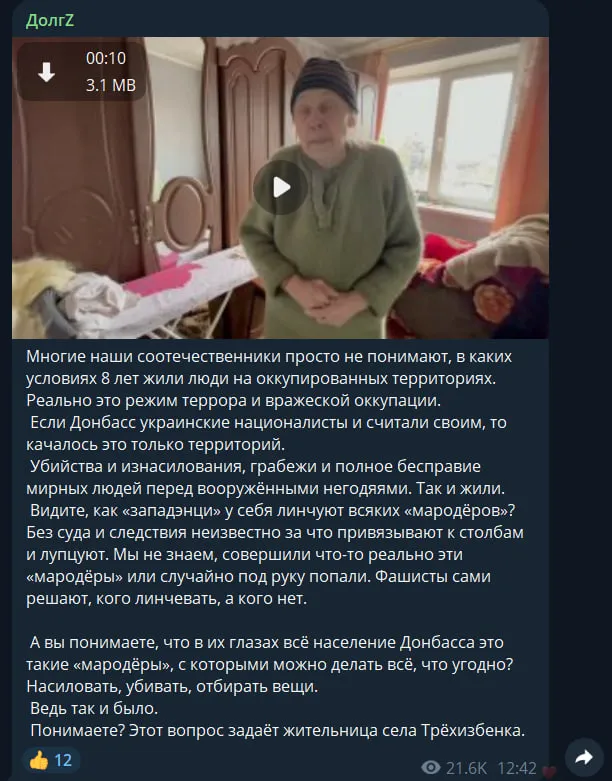
Screenshot: the DolgZ Telegram channel, 5 March 2022, 12:32 and 12:42.
Dolgachev also spells out this opposition more directly. DolgZ reposted a message from the Dolgachev Speaks channel arguing that, in the struggle between Good and Evil, neutrality is itself a form of evil, and that attempts to whitewash Evil are incompatible with objectivity. In other words, even the possibility of distancing oneself from either side is rejected. The audience is not invited to assess specific actions, but instead told to choose which side it is on. It is important to note that this was a repost, not an original post by Dolgachev on DolgZ. Nevertheless, sharing it shows which formulations he chooses to amplify in his own information space.
A similar way of assigning responsibility can be seen in a post about a residential building destroyed on Vatutina Avenue in Donetsk. The forwarded message claimed that Ukrainian forces had struck the city centre with Grad multiple-launch rocket systems, destroying the building and killing its residents. The author attributed the deaths of civilians to their supposed unwillingness to live by rules imposed by the West. The tragedy is thus immediately given a political explanation: responsibility is placed on Ukraine, while the victims become part of a broader narrative about Russia’s confrontation with the West. This was not Dolgachev’s own text, but a forwarded post. It is therefore more accurate to say that he circulated this interpretation of civilian deaths than to attribute the claim directly to him.
Against this backdrop, his treatment of developments unfavourable to the Russian military is particularly revealing.
In November 2023, Dolgachev acknowledged that Ukrainian forces had established a bridgehead on the Dnipro River. However, he did not examine why Ukrainian troops had managed to secure their positions or raise the question of the Russian command’s responsibility. Instead, he warned his audience against complacency and promised the enemy surprises in the spring. In this case, the military problem was not denied, but acknowledging it did not lead to any critical assessment of his own side. An inconvenient fact was turned into a call for mobilisation.
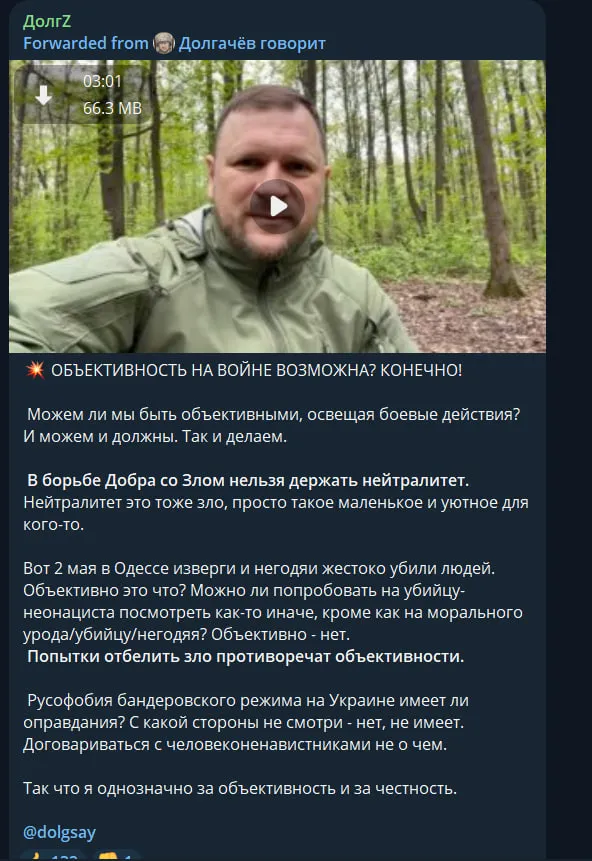
Screenshot: a post reposted by DolgZ from the Dolgachev Speaks Telegram channel, 3 May 2023.
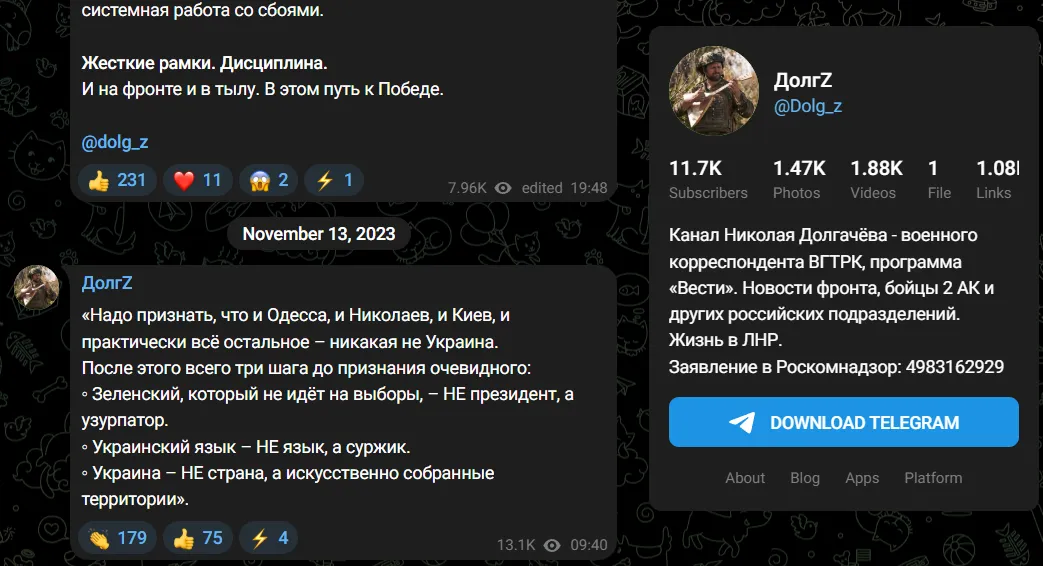
Screenshot: the DolgZ Telegram channel, 13 November 2023.
Another element of this pattern is the normalisation of Russian casualties. On 15 February 2026, Dolgachev wrote that troops should never be withdrawn from any position, and that annual losses of 1,500 soldiers in Afghanistan had been “acceptable”. He referred to a fallen comrade from the Popular Front as a Hero. Here, human losses are not treated as grounds for questioning the necessity of military operations or reconsidering military decisions. Instead, they are explained in terms of the need to hold positions, a willingness to make sacrifices and the heroism of those killed. The comparison with Afghanistan is used to justify the idea that a certain level of casualties can be considered an acceptable price for continuing the war.
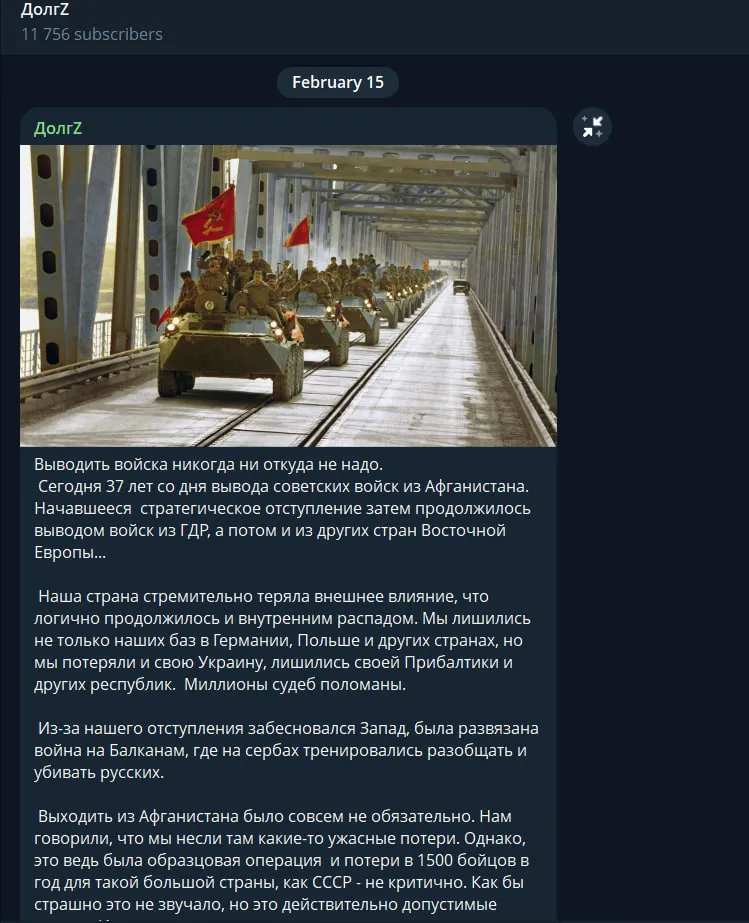
Screenshot: the DolgZ Telegram channel, 15 February 2026.
Dolgachev’s political loyalty is also reflected in his attitude towards Putin. In October 2026, he congratulated the Russian president on his birthday and spoke of the “Putin Era”. This episode is not a direct response to a military setback or casualties, but it fits the broader picture of his public stance: criticism of the Russian leadership does not feature in the way he explains the course of the war.
Overall, the material examined here suggests that Dolgachev does not necessarily conceal developments that reflect poorly on Russia. He may acknowledge military retreats, report casualties and share accounts of problems on the front line. However, he does not treat these developments as grounds to question his own side’s position or reassess the war itself. Ukrainian setbacks are portrayed as evidence of the enemy’s weakness or criminality, while problems facing the Russian military become arguments for greater resilience and mobilisation. Russian casualties, in turn, are framed as an acceptable price of the struggle and a form of heroic sacrifice.
Dolgachev’s approach is characterised by a moral justification of the war, framed as a struggle between Good and Evil. He delegitimises Ukraine, shifts responsibility for civilian casualties onto the opposing side and normalises Russian military losses.
Yegortsev: The Sanctification of War
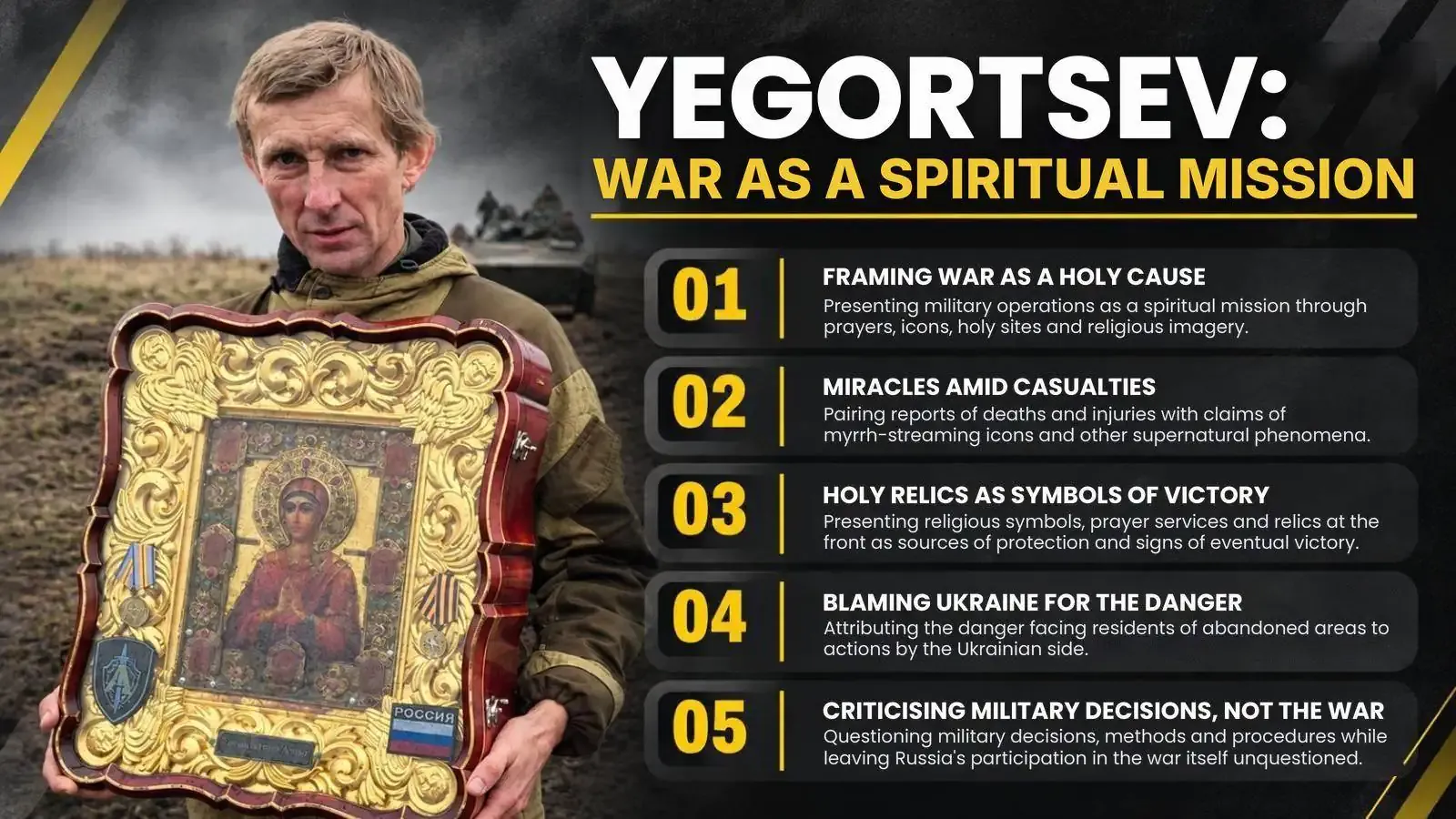
Alexander Yegortsev is a special correspondent for Spas, a Russian Orthodox television channel. He graduated from the Faculty of Philology at Moscow State University in 1996 and completed postgraduate studies in the Department of Philosophy of Religion in 1999. He has worked for Spas since 2018. On 20 February 2022, he began filming reports in Donbas, and on 15 April 2022, he broadcast live from Mariupol.
Profile on Myrotvorets: identifies him as a war propagandist, an anti-Ukrainian propagandist and an accomplice of the occupiers who took part in Russian propaganda activities targeting Ukraine. An entry dated 28 September 2025 also accuses him of knowingly violating Ukraine’s border in order to visit occupied territories.
I published a profile of Yegortsev on 3 March 2026. It noted that the special correspondent supports the war and frequently visits occupied cities. In February 2026, he publicly reported from cities in occupied Luhansk region. The profile did not address military losses or failures, so this part of the article is based solely on his own posts and broadcasts.
In Yegortsev’s reporting, death and injury are often framed in religious terms. War is presented not simply as a military confrontation, but as an event imbued with sacred meaning through prayers, icons, relics and accounts of miracles. This brings combat operations and human casualties into the same narrative as religious symbols, giving the violence of war an additional spiritual dimension.
In November 2022, Rossiyskaya Gazeta reported a similar incident in the so-called “LPR”. During a prayer service attended by fighters from the Rus and Alexander Nevsky battalions, an icon of the Mother of God reportedly began to exude myrrh. The incident was shared on Telegram by journalist Yuri Kotenok. This was not Yegortsev’s report, but it illustrates the broader media environment in which religious phenomena are linked to Russian troops and their participation in the war.
In April 2023, Spas aired Yegortsev’s report The Path of a Warrior, dedicated to the memory of Vladlen Tatarsky. In late August that year, the channel forwarded another post by him: an icon had reportedly begun to exude myrrh as two severely wounded soldiers and one fallen soldier were being evacuated from the battlefield. In this account, a religious symbol is directly associated with an event involving military casualties. The soldiers’ injuries and deaths become part of a story about an alleged supernatural occurrence, which is then used to give the war a religious interpretation.
In October 2023, Yegortsev was attacked in Listvyanka. At the time, however, he was travelling with a missionary cross procession, and the incident had no connection to the front line. On 12 February 2024, Spas broadcast a prayer service near the front line, held in the presence of the relics of Demetrius of Thessaloniki and Alexander Nevsky. Yegortsev joined the broadcast. In spring 2026, the channel aired A Journalist in the Trenches, a programme in which soldiers said that victory follows wherever an icon is present.
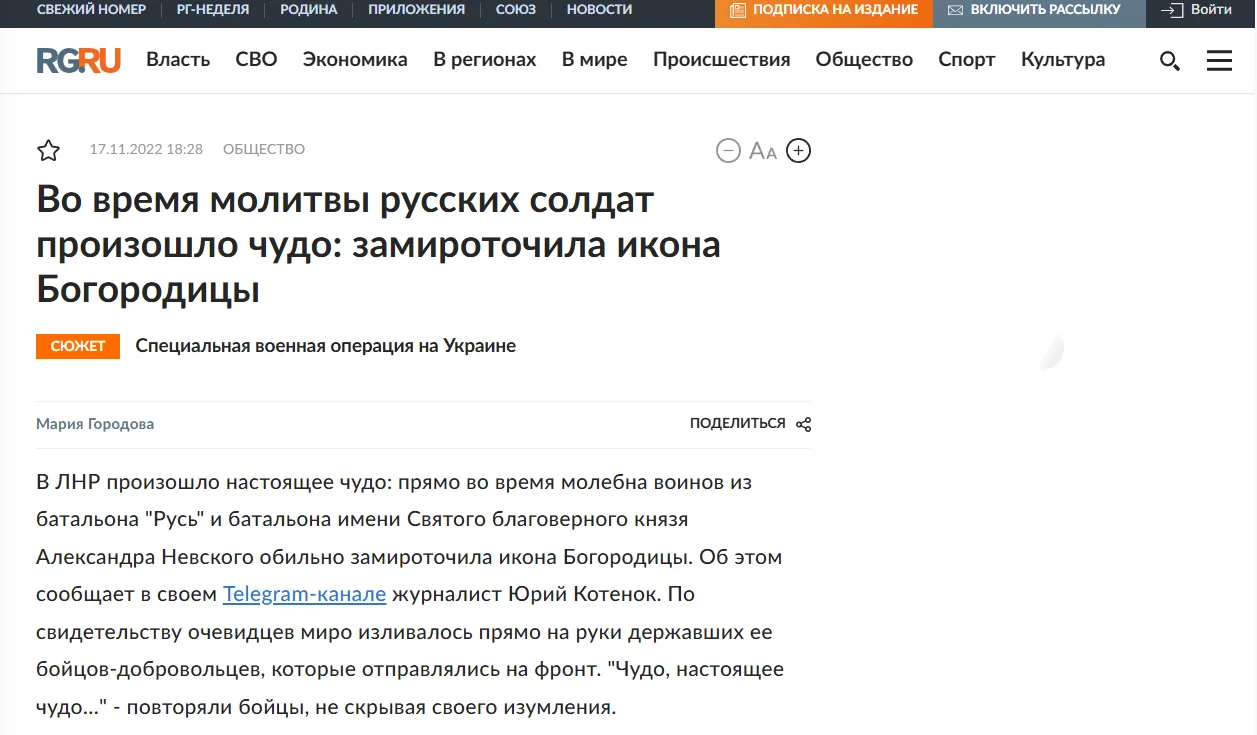
Screenshot: Rossiyskaya Gazeta, 17 November 2022.
Yegortsev’s personal Telegram channel, Egortsev_TV, which has around 3,500 subscribers, offers a look at how this rhetoric works outside the framework of television reporting. Alongside religious and frontline content, it features posts about retreats, casualties and the need to change the way the war is being conducted. It is important, however, to distinguish between Yegortsev’s own statements and material forwarded from other authors. Sharing a post does not automatically mean that he personally endorses every claim it contains.
In October 2022, Yegortsev forwarded a post by German Sadulayev stating that people were “fleeing towns and villages abandoned by our army”. The post blamed Ukraine, claiming that Ukrainian forces would torture and kill those who remained. The Russian withdrawal is not denied, but its consequences are explained through the alleged threat posed by the enemy. Responsibility for the danger facing local residents is thus shifted away from the Russian forces leaving the settlements and onto Ukraine. The wording belongs to Sadulayev, not Yegortsev, who shared the post on his channel.
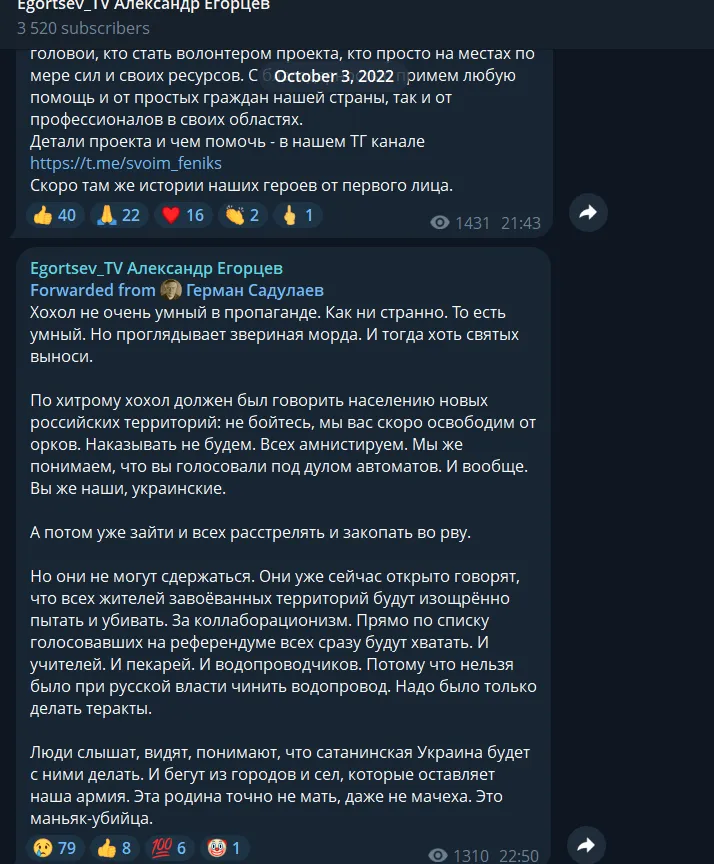
Screenshot: the Egortsev_TV channel, 3 October 2022, a forwarded post by German Sadulayev.
A post dated 27 May (the year is not visible in the screenshot) raises the question of whether the approach to the war can be changed “systematically, decisively and promptly”. The answer reads: “It is difficult, but probably possible. And vitally necessary”, provided it does not end up like the previous occasion: “It’s possible. But why?” The author refers to a post by Andrey Medvedev.
This post goes beyond justifying individual decisions. It reflects concern about the effectiveness of Russia’s conduct of the war and the need to change its approach. But the proposed change is about making military efforts more systematic, decisive and effective, not reconsidering Russia’s involvement in the war itself. Without the original post’s full context or a confirmed publication year, it would be premature to attribute a specific reform agenda to Yegortsev. The fact that he chose to share the message is nevertheless relevant.
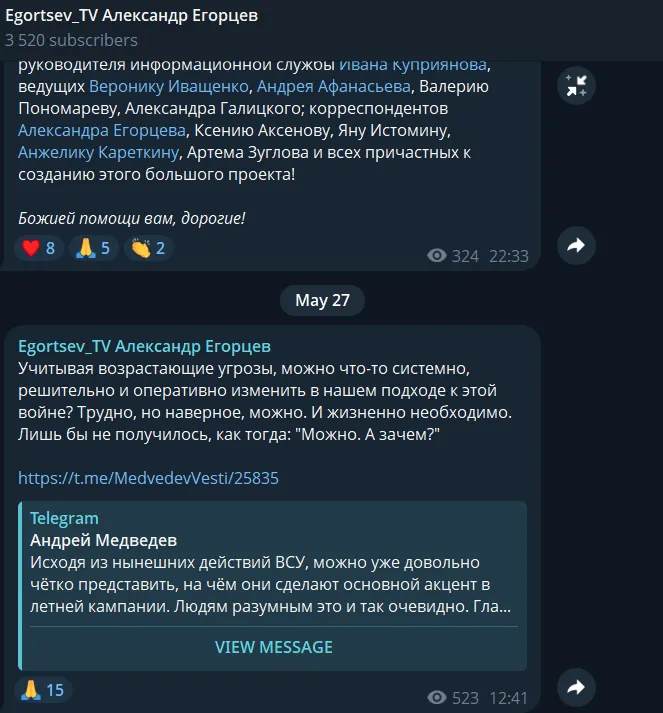
Screenshot: the Egortsev_TV channel, 27 May.
Another post, whose opening section is missing from the screenshot and which predates a publication dated 7 October 2023, addresses soldiers whose bodies were left on the battlefield but who continued to be officially listed as “missing”. The author says that a new law allows a serviceman to be declared dead six months after his death, calls this a half-measure and asks why the authorities cannot do it sooner. The losses are acknowledged directly, but the criticism is aimed at the procedure for formally recognising deaths.
The focus here is on how military deaths are recorded and legally confirmed. The post raises the issue of servicemen whose bodies remain on the battlefield, but does not examine why they were left there or who bears responsibility for those circumstances. Instead, it questions how long the state should take to officially recognise them as dead. The criticism concerns the administrative handling of casualties, not the way the military operations themselves are conducted.
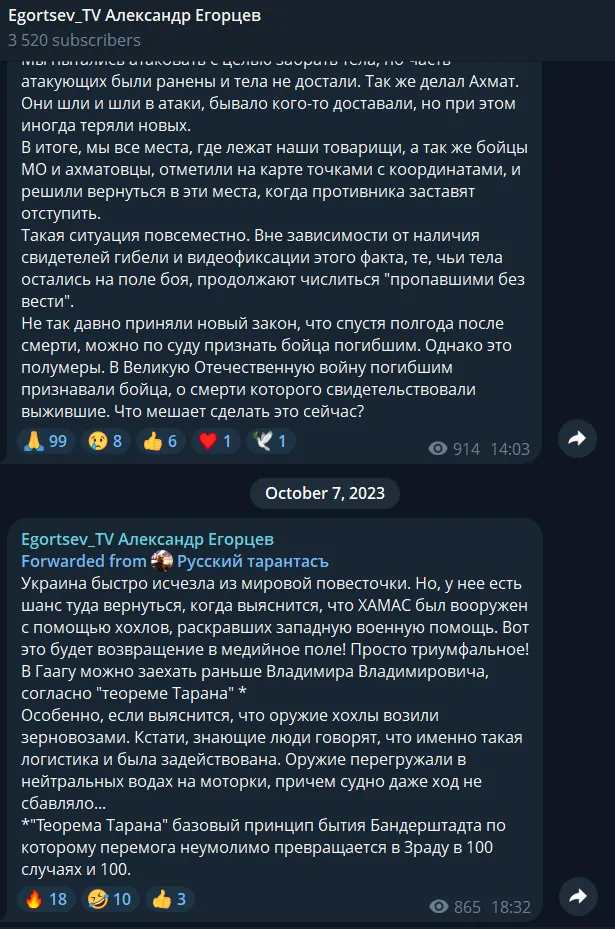
Screenshot: the Egortsev_TV channel, a post about missing servicemen and a post dated 7 October 2023.
In October 2025, the channel published a Spas report titled The Path of a Warrior, about a hierodeacon who had previously served as an officer in Group A of the KGB of the USSR. It is another example of military and religious themes being brought together. The biography of a man with a background in the Soviet security services is presented through the image of a warrior and his spiritual journey.
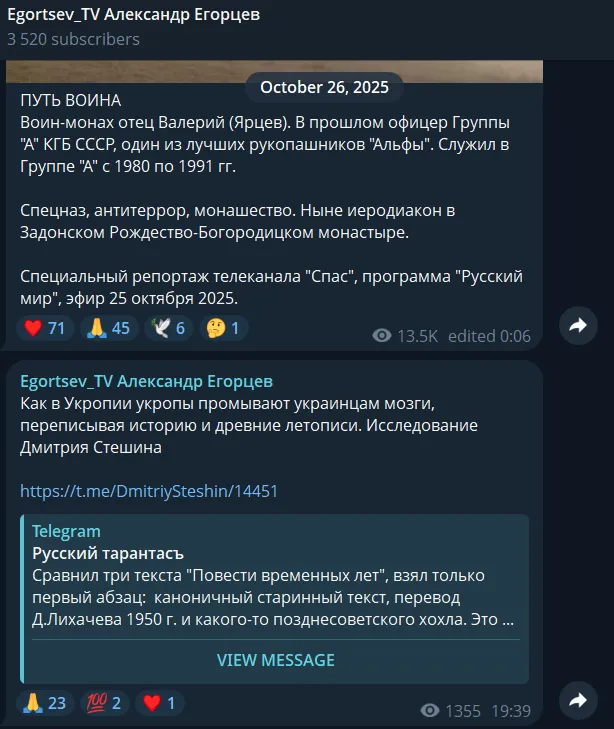
Screenshot: the Egortsev_TV channel, 26 October 2025.
Two interconnected themes emerge from Yegortsev’s material.
The first is the religious framing of war. Combat operations, soldiers and military casualties are presented alongside prayers, icons, relics and accounts of miracles. This combination gives the war a sacred dimension and portrays the soldier’s participation in combat not merely as military service, but as part of a spiritual journey.
The second is criticism of specific military decisions and procedures. Retreats are acknowledged, casualties are discussed, and problems with recording the dead and the conduct of military operations are raised publicly. Yet in the examples examined here, this criticism does not amount to rejecting the war or questioning Russia’s responsibility for starting it. It focuses instead on how to make military operations more effective and how to address the problems arising from the war more quickly.
Yegortsev’s coverage therefore combines a religious interpretation of war with limited criticism of its practical consequences. On Spas, military operations are given a sacred framework. On his personal channel, retreats and casualties can be acknowledged, but the discussion tends to focus on the enemy’s actions, the need to change military tactics or improve administrative procedures. This allows the consequences and shortcomings of the war to be discussed without challenging the underlying premise of Russia’s military campaign.
Vorsobin: Talking About the War Through Other People’s Words
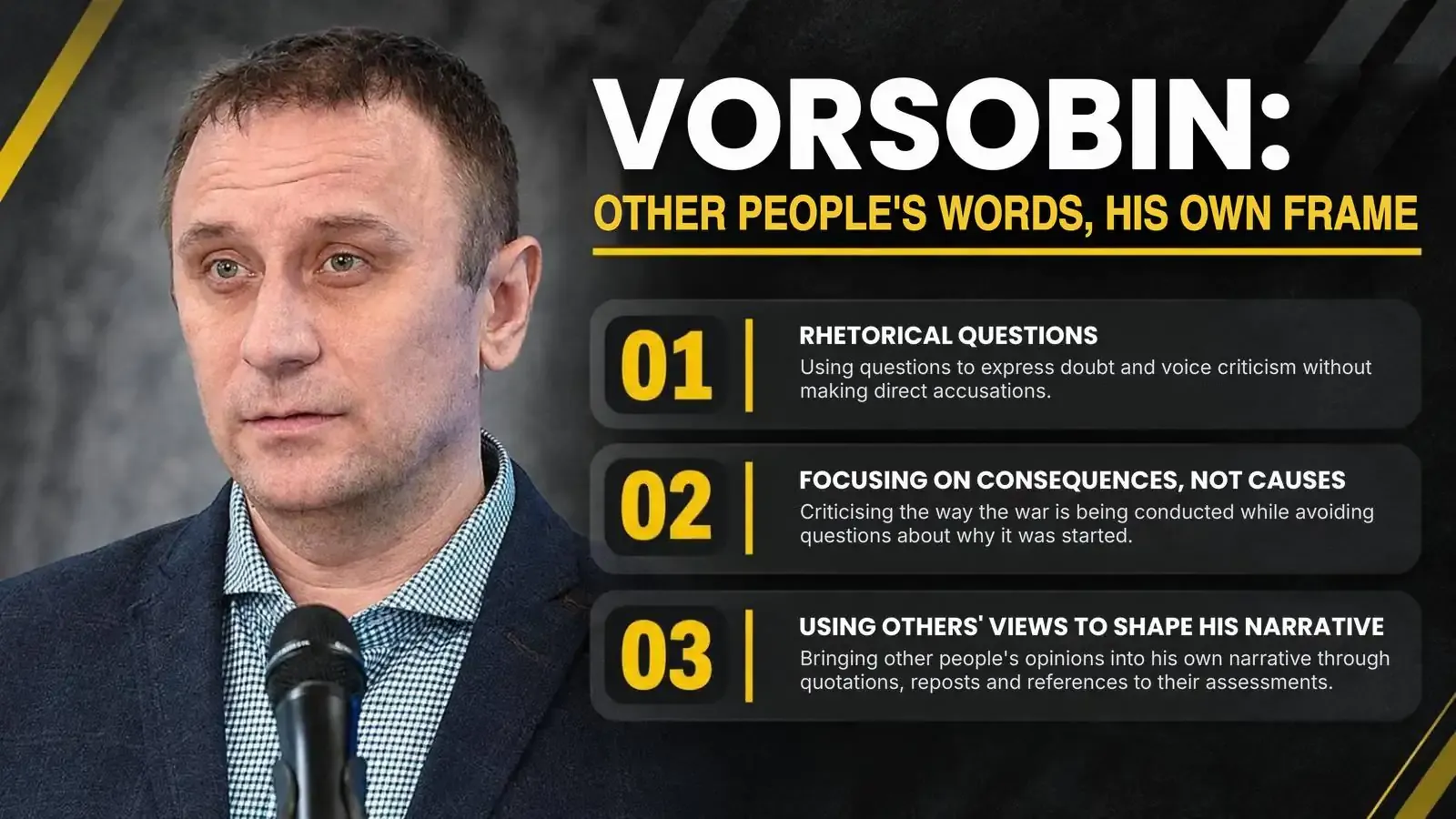
Vladimir Vorsobin is a political commentator for Radio Komsomolskaya Pravda, a special correspondent for the publication since August 1999, and host of the programmes Civil Defence and On the Matter. He was born on 10 February 1973 in Saransk. In 2016, he received a Russian government award for media. On 22 October 2025, he was awarded the Medal of the Order of Merit for the Fatherland, 2nd Class. His profile on the Radio Komsomolskaya Pravda website: https://radiokp.ru/people/vladimir-vorsobin-0.
Vorsobin is neither a conventional war correspondent who regularly reports from the front line nor a self-described “military patriot”. This study looks at him as a Russian media commentator who shapes how his audience perceives the invasion, the occupation and their consequences. His material offers insight into how these issues are brought into mainstream political, economic and social debate.
Profile on Myrotvorets: accused of knowingly violating Ukraine’s state border to enter occupied Crimea, participating in Russian propaganda activities targeting Ukraine, and attempting to legitimise the occupation of Crimea.
In January 2020, Vorsobin visited Crimea for the first time since its occupation, travelling there as a special correspondent for Komsomolskaya Pravda. His report, Why Russian Businesses Find Themselves in a Bureaucratic Hell in Paradise Crimea (13 January 2020): https://www.kp.ru/daily/27077.7/4148061/. In June 2026, he returned to the peninsula and published Crimea Is Not Afraid of Blockades: What Life on the Peninsula Is Really Like Today. In January 2022, he was in Almaty during the unrest, where he was attacked by a crowd armed with rebar, sticks and crowbars. According to the journalist himself, his Komsomolskaya Pravda press card saved him.
According to his profile on the OsintFlow website (Nick Bell, 23 September 2026): https://osintflow.com/news/vorsobin-volodimir-volodimirovich/, he initially spoke out against the outbreak of the war. Later, he hinted at disagreement with the current Russian leadership, although that criticism soon faded. He now describes the war as a “game played by politicians” and regularly forwards and comments on statements by Peskov, Putin and other officials about the terms for a ceasefire. The evolution of his Telegram channel, outlined below, follows a similar trajectory.
On 16 February 2022, just days before the full-scale invasion, Vorsobin publicly supported Russia’s recognition of the so-called “DPR” and “LPR” during a broadcast on Radio Komsomolskaya Pravda: “I support recognising Donbas. Yes, I do. Because you cannot keep people suffering for so long.”
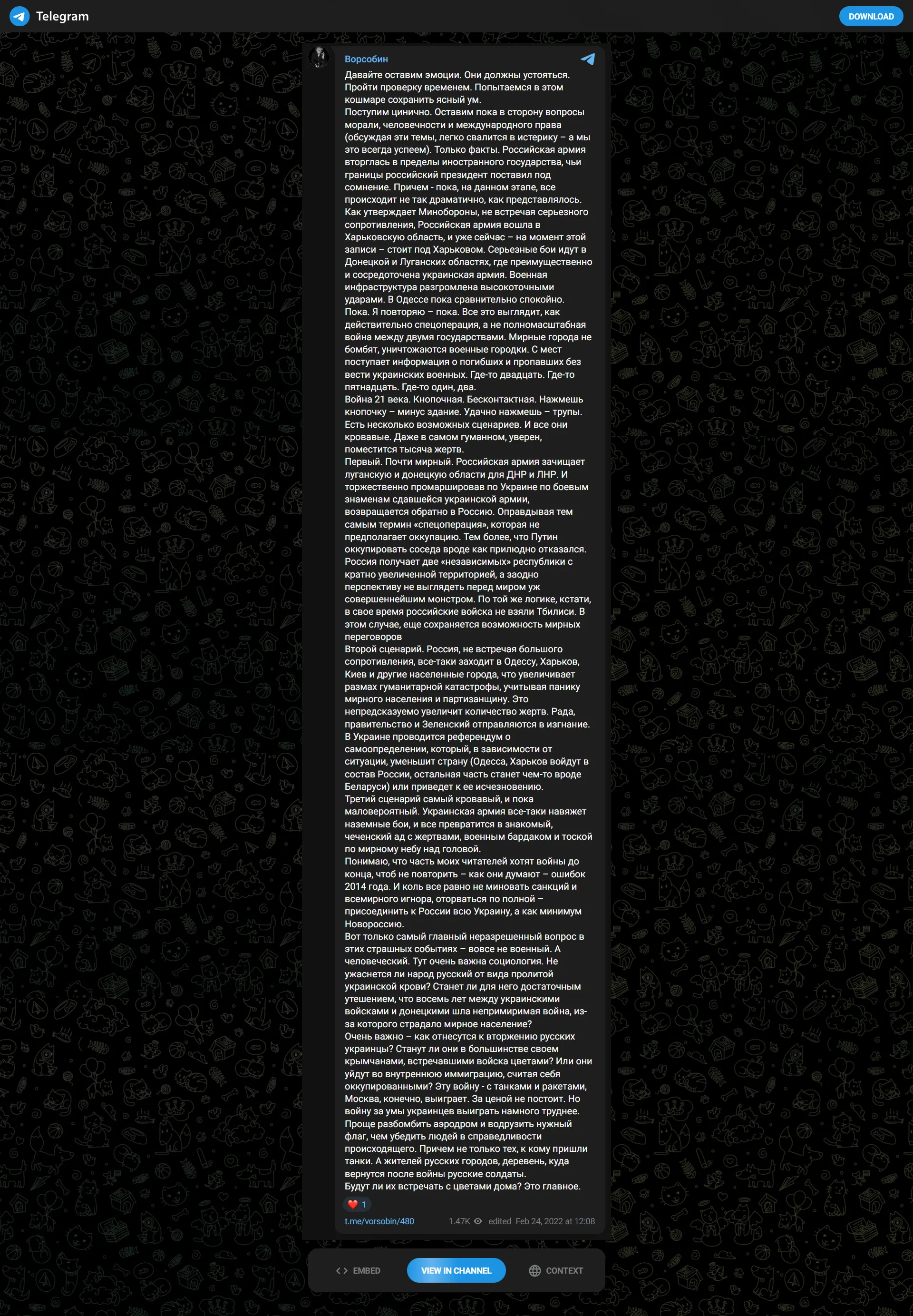
Screenshot: the Vorsobin Telegram channel, 24 February 2022.
On 24 February 2022, the first day of the full-scale invasion, Vorsobin published a lengthy post outlining three possible scenarios for how the war might unfold. He proposed setting aside questions of morality, humanity and international law and focusing instead on “the facts”. He then repeated claims made by the Russian Ministry of Defence: that the Ukrainian army was putting up little resistance, its military infrastructure had been destroyed and civilian cities were not being bombed.
His scenarios included the capture of Luhansk and Donetsk regions, followed by the withdrawal of Russian troops to Russia; an expansion of the occupation to include Odesa, Kharkiv, Kyiv and other cities, the removal of Ukraine’s government and a possible partition of the country; and a prolonged ground war resembling the Chechen wars. In one scenario, he explicitly suggested that Odesa and Kharkiv could become part of Russia, while the rest of Ukraine would turn into something resembling Belarus.
Vorsobin also focused on how the Ukrainian population might respond. Would Ukrainians welcome Russian troops with flowers, as he claimed Crimeans had done, or would they see themselves as an occupied population? He argued that the main question was not military victory, but whether Moscow could persuade Ukrainians that what was happening was “just”. He also wondered whether Russian society would be horrified by the bloodshed in Ukraine and whether Russians would continue to support the war afterwards.
In this post, Vorsobin acknowledges the possibility of heavy casualties and Ukrainian resistance, but treats them primarily as obstacles for Russia. The invasion, the capture of cities and the possible partition of Ukraine are presented as scenarios for political and military developments. Ukraine’s right to its own territory and to determine its future independently is pushed outside the discussion. His reservations focus mainly on the cost of the war for Russia and the difficulty of maintaining control over occupied territories.
On 1 March 2022, the sixth day of the invasion, he wrote on his personal channel, which had around 3,500 subscribers, that the war was first and foremost a source of personal anxiety for him. He predicted an “Iron Curtain”, a wooden ruble, shortages, relentless propaganda and “all-Russian poverty”, comparing the situation to Venezuela and Cuba. He asked what the “bloodbath” was supposed to achieve.
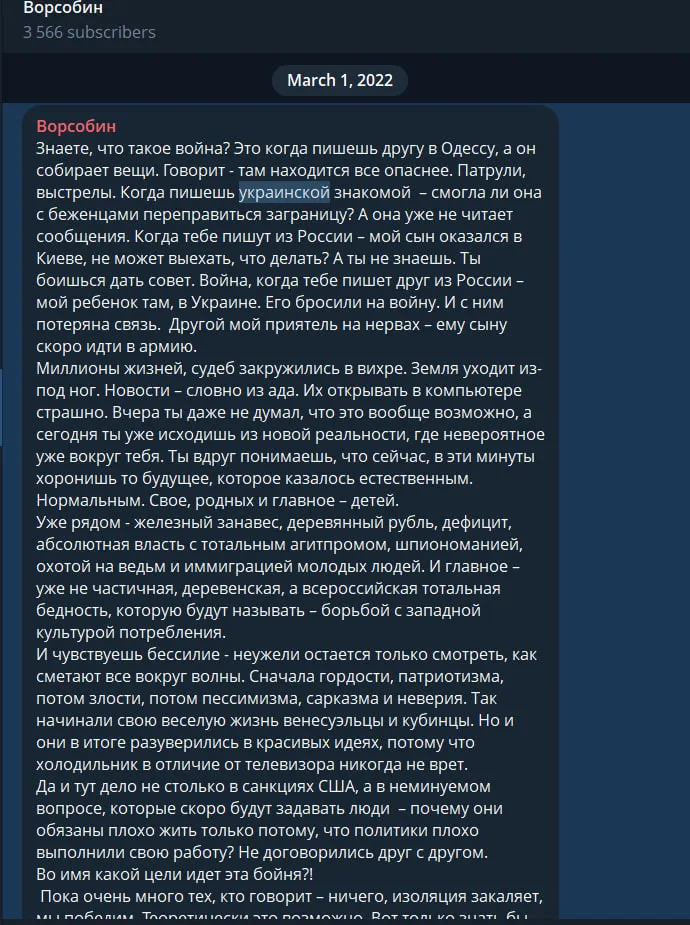
Screenshot: the Vorsobin Telegram channel, 1 March 2022.
Ten days later, on 11 March, he spoke ironically with Joseph Prigozhin on air about those “fleeing” Russia, ending the conversation by wishing happiness to both those who had left and those who had stayed. On 14 October 2022, he discussed with a sociologist what Russians feared more: mobilisation or a nuclear strike.
The tone of his channel gradually changed. In June 2023, Vorsobin forwarded a post by Galiya Ibragimova in which one woman called for Ukraine to be “bombed”, while the author’s mother could not understand how anyone could support Putin. The visible part of Vorsobin’s post contains no assessment of his own. In September 2024, he expressed scepticism about Russia’s economic policy and argued that peace without Ukraine’s capitulation was a compromise Moscow would not accept.
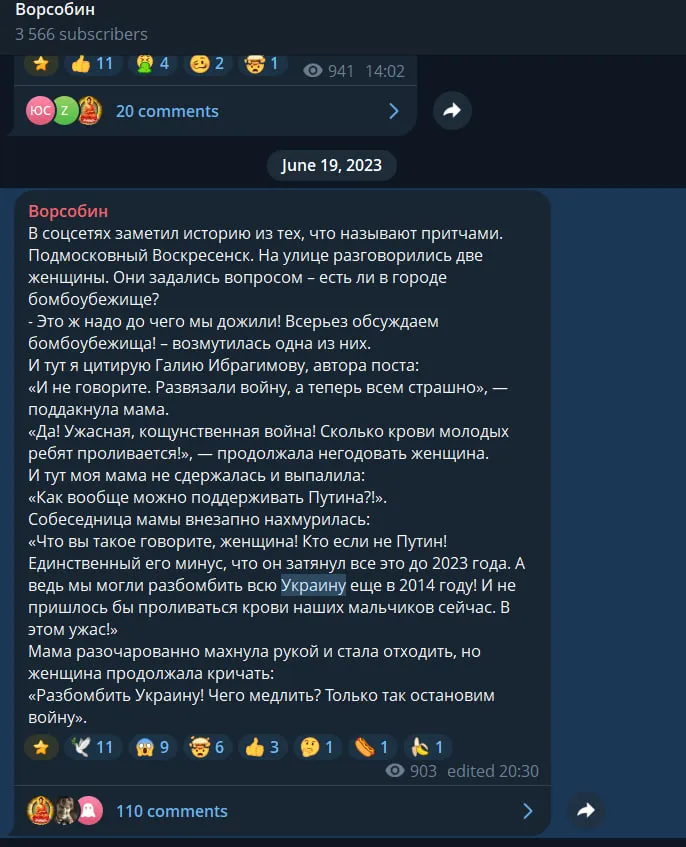
Screenshot: the Vorsobin Telegram channel, 19 June 2023.
In a piece examining the economic benefits Russia might derive from annexing Ukrainian territories, Vorsobin describes a discussion among experts about how much territory Russia actually needs: Donbas and Kherson, or also Odesa, Dnipro, Kyiv and Lviv. Ukrainian land is discussed in terms of its industrial potential, agriculture and the possible economic returns for Russia.
Vorsobin directs his own criticism at the inefficiency of the Russian state apparatus, which, in his view, is incapable of organising normal life in the territories it has seized. He acknowledges that rebuilding after destruction is harder than capturing a city, but does not question Russia’s right to lay claim to Ukrainian territory. Instead, he discusses how to build an effective economy in the territories Russia “considers its own”.
This illustrates a recurring feature of Vorsobin’s criticism: he can be sharply critical of Russian bureaucracy, military leadership and economic failures, but his criticism targets the methods and effectiveness of implementing Russian policy, not the occupation itself. In the first instance, he considers the possible scale of Russia’s territorial gains in Ukraine; in the second, he examines the economic challenges of governing the occupied territories.
On 25 June 2026, during a radio broadcast, he relayed Crimeans’ comments about the “hand of Moscow”. In August 2026, he forwarded a post titled Searching for the Goals of the SVO. On 24 August, he posed an ambiguous rhetorical question about how to “finally resolve the problem” of Ukrainian independence. In these posts, the question of the war’s purpose, which had featured in his commentary in 2022, is no longer raised directly.
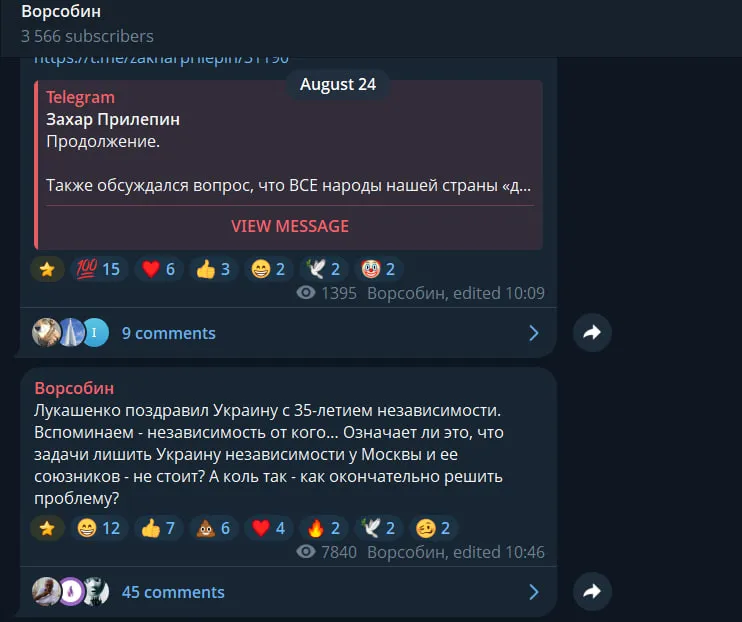
Screenshot: the Vorsobin Telegram channel, 24 August 2026.
Communication Style
Vorsobin’s public communication style is polemical, emotional and ironic. During broadcasts, he uses provocative and leading questions, reframes his guests’ positions, challenges their arguments and sets the terms of the discussion. In his own posts, he often relies on rhetorical questions, everyday analogies and conversational language.
At the same time, he does not use the openly hateful language common among some Russian war correspondents. He does not bombard his audience with insults directed at Ukrainians or resort to direct threats. On the surface, his writing resembles critical journalism: he questions government decisions, acknowledges military and economic failures, and discusses human casualties and public discontent.
In the posts and broadcasts examined here, Vorsobin does not directly challenge Russia’s claims to Ukrainian territory. Instead, he focuses on possible scenarios for the course of the war, the economic and social consequences of occupation, and the effectiveness of Russian administration in the territories it has seized. His criticism is directed primarily at the actions of the Russian authorities and the difficulties they face in implementing their policy towards Ukraine.
Another recurring technique is distancing himself through other people’s words. Vorsobin recounts and shares statements by others, not always adding his own assessment. This allows him to bring a range of positions, including radical ones, into his information space without explicitly endorsing them. In such cases, it is important to distinguish between his own statements, quotations and reposts.
Overall, his communication is characterised less by overt aggression than by a journalistic tone and an appearance of critical distance. He can present himself as an independent commentator while keeping the war and Russia’s territorial claims within the bounds of ordinary political and economic debate. One of the key patterns in his material is criticism of the methods while leaving the objectives intact.
Fighterbomber: Selective Candour and the Limits of Criticism
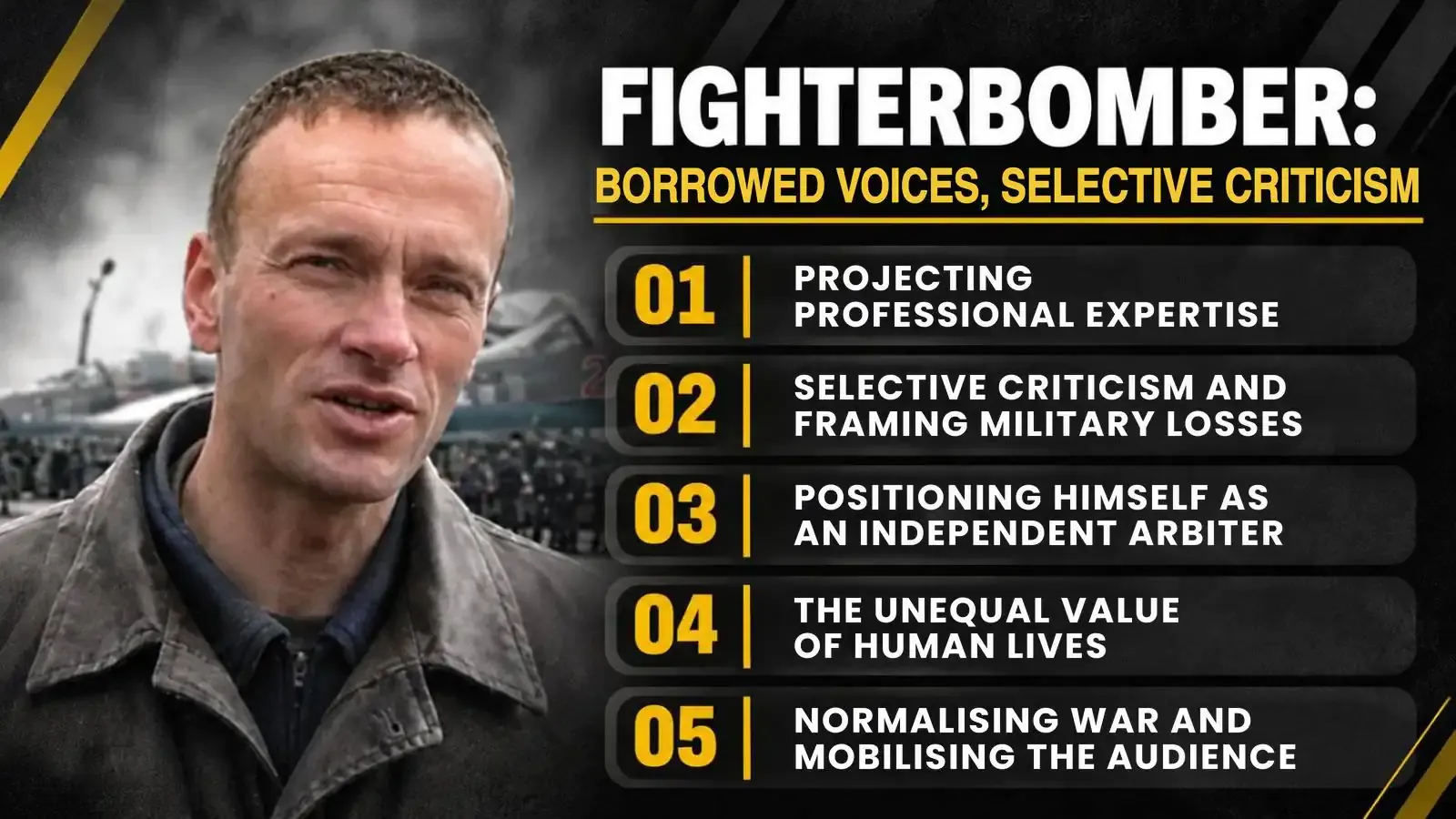
The anonymous Telegram channel Fighterbomber was long presented as the voice of an industry insider. In June 2023, our colleagues at the OSINT Bees project identified the person behind the channel as Ilya Tumanov, a Russian Air Force captain and former Su-34 navigator’s assistant from Voronezh.
In November 2023, the Russian outlet Sirena found only circumstantial evidence linking Tumanov to the channel and noted that several people were involved in running it. For this reason, the term “author” in this article refers to the channel itself. Tumanov’s identification was subsequently included in the Mouthpieces of the Kremlin database (entry dated 18 May 2026). Ukraine imposed sanctions on him under Presidential Decree No. 588/2026. However, his authorship of the channel has not been legally established. In March 2022, the Russian Ministry of Defence published a military-patriotic song performed by him.
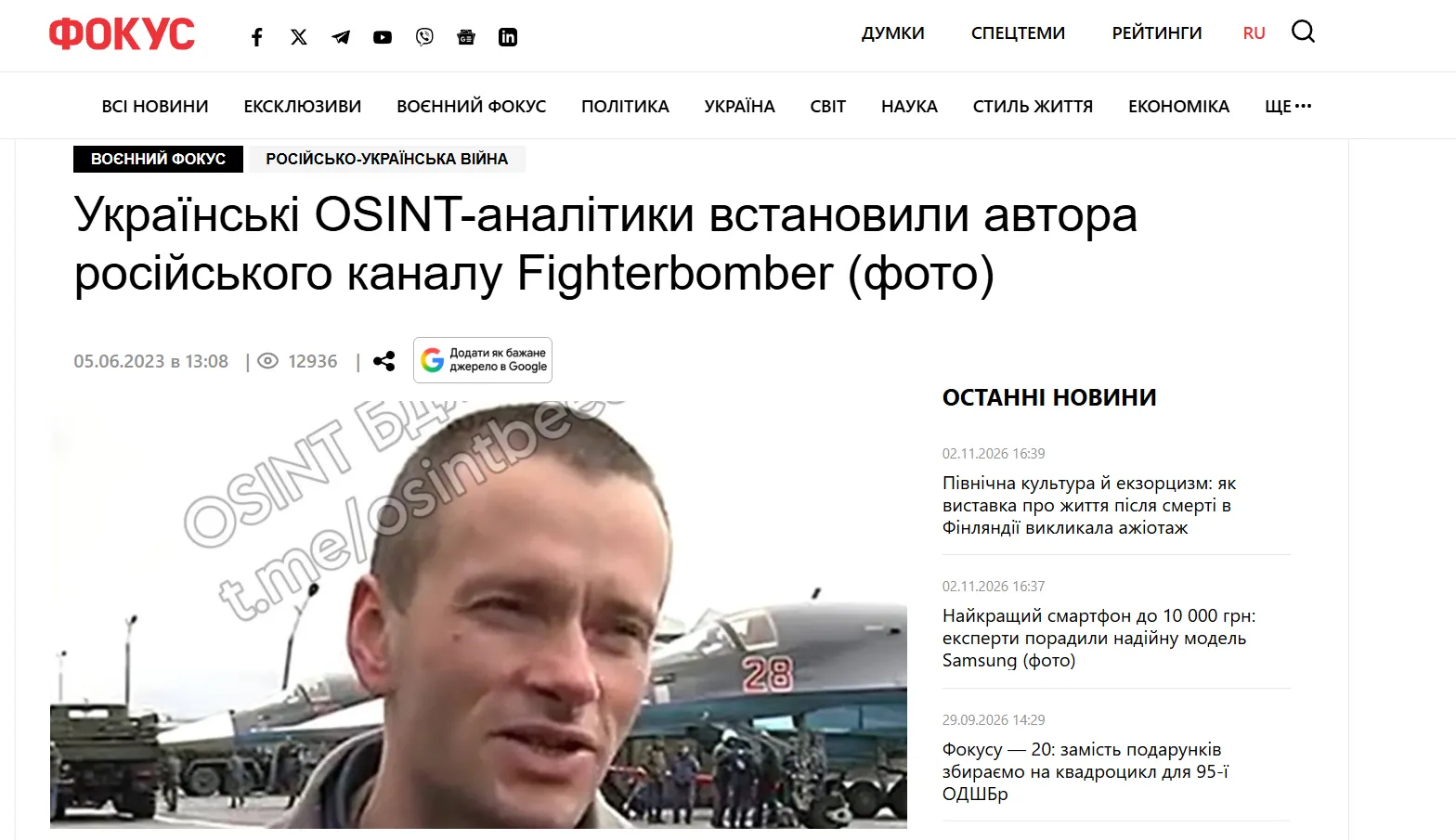
Screenshot: Focus, 5 June 2023, article on the identification of the channel’s author.
Fighterbomber does not completely conceal Russian losses. The channel reports downed aircraft, aircrew fatalities, damage to airfields and problems with military infrastructure. What matters, however, is not only which events are acknowledged, but also how the author explains them.
In post No. 8157, addressing the aftermath of the strike on Novofedorivka, the author says he has no questions about why or how it happened. At the same time, he expresses hope that the highest levels of the Russian leadership will receive complete and truthful information about the causes, losses and measures taken, rather than just the explanations offered by military correspondents hastily summoned “for a dressing-down”. He also notes that satellite imagery could help establish the extent of the damage.
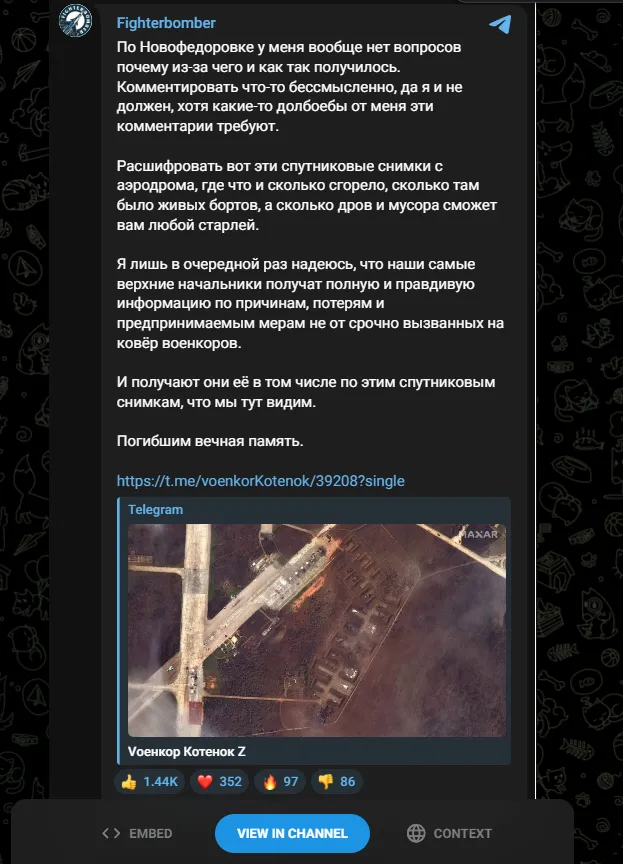
Screenshot: Fighterbomber channel, post No. 8157.
In post No. 14466, dated 22 October 2023, the author discusses losses suffered by Russian aviation as a result of its own air defence systems. According to him, the first losses in this war were caused by Russian air defences, and the crew of the most recently downed aircraft may have met the same fate. He criticises a situation in which aircrews are forced to evade missiles fired by their own forces, while investigations into such incidents lead to no tangible changes.
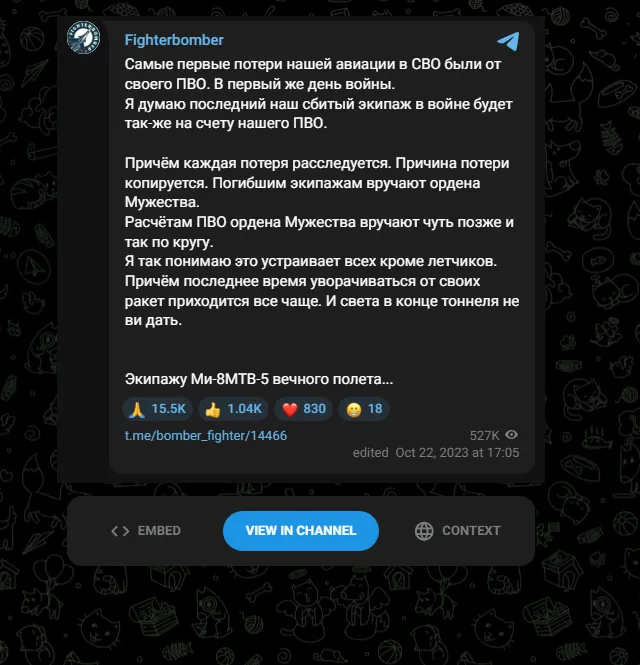
Screenshot: Fighterbomber channel, post No. 14466.
In post No. 14892, dated 30 November 2023, the author claims that losses caused by technical failures, human error and indiscipline among military personnel themselves are many times higher than those caused by enemy air defences. He provides no evidence to support this statistic.
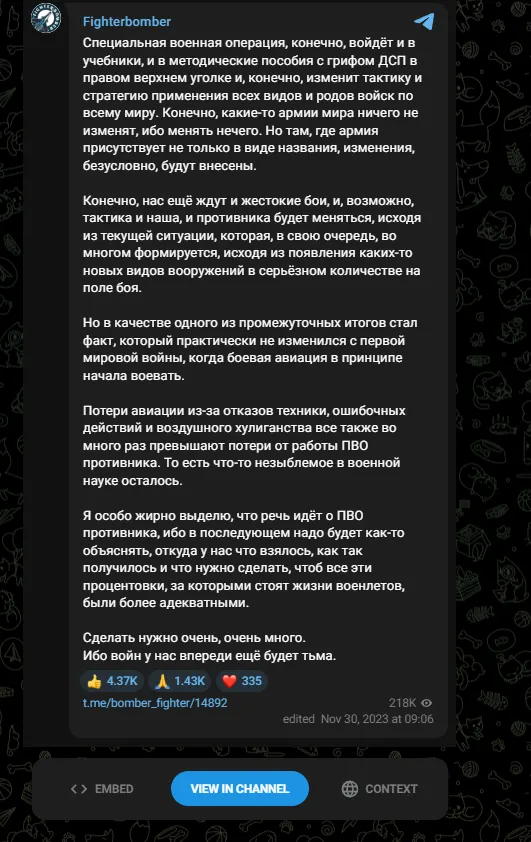
Screenshot: Fighterbomber channel, post No. 14892.
In other cases, losses are presented as an inevitable part of intense combat. In post No. 17655, dated 6 August 2024, the author acknowledges that the scale of the fighting means losses will continue, but assures readers that everything necessary is being done and that, in the end, everything will be fine. In post No. 19420, published on 1 January 2025, the deaths of Russian aircrews towards the end of the previous year are described in a commemorative tone.
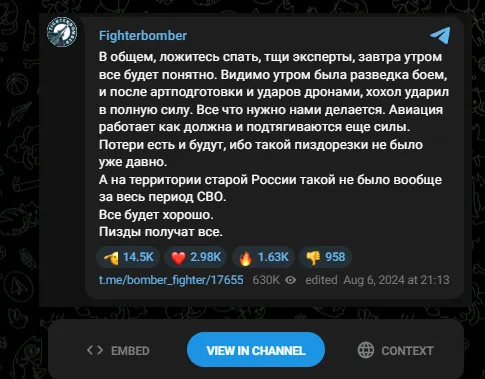
Screenshot: Fighterbomber channel, post No. 17655.
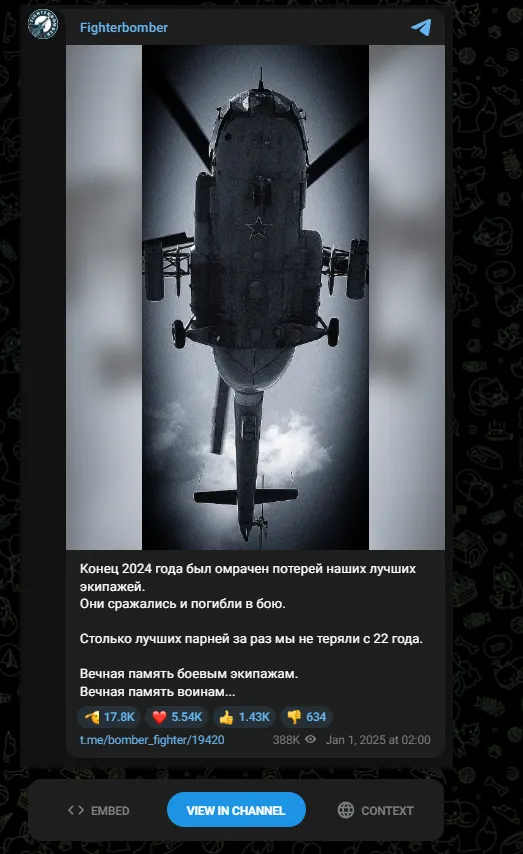
Screenshot: Fighterbomber channel, post No. 19420.
The communication technique here is control over the interpretive framework. Losses are not necessarily denied. Instead, the audience is offered ready-made explanations: the demands of combat, technical failures, crew errors, Ukrainian air defence or shortcomings in military command. This approach allows the channel to appear candid without abandoning its overall support for the war. Acknowledging problems does not amount to questioning the war’s objectives.
Devaluing Ukrainian Losses and the Unequal Worth of Human Lives
The channel adopts a very different tone when discussing Ukrainian losses. On 27 August 2023, it mocked the Ukrainian practice of burning pianos in memory of fallen pilots. The author advised every Ukrainian Air Force pilot to arrange for a piano to be bought while they were still alive and suggested that military units keep a supply of pianos “already signed” in advance. The post received 347,000 views.
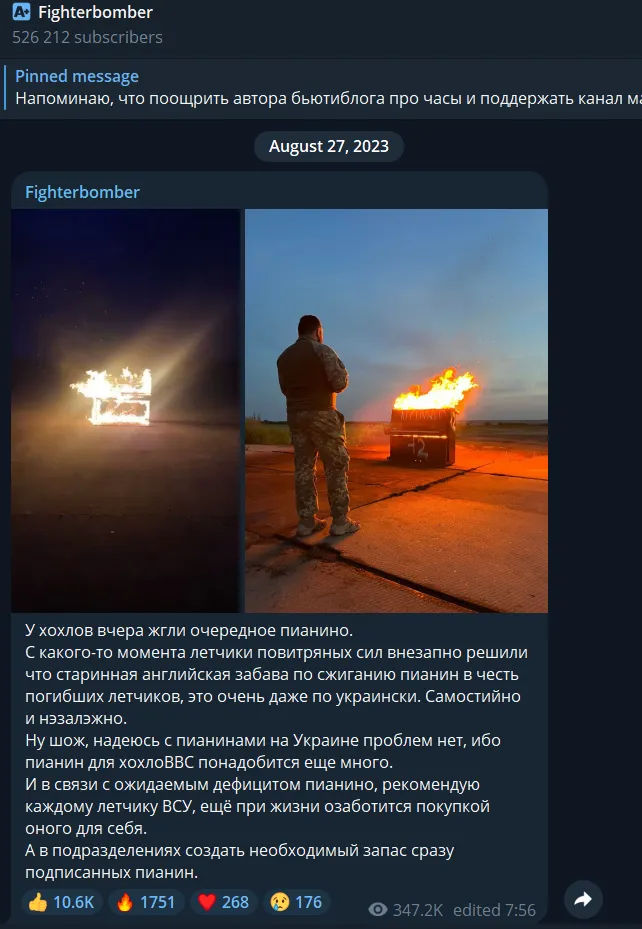
Screenshot: Fighterbomber channel, 27 August 2023.
This goes beyond making an ironic remark about a commemorative tradition. The author turns the memory of fallen Ukrainian service members into a subject of ridicule, while portraying the deaths of Russian aircrews in an entirely different light. In post No. 19420, dated 1 January 2025, for instance, he describes fallen Russian pilots as the finest people who gave their lives in combat.
The contrast is most explicit in post No. 20671, dated 14 April 2025, which addresses the deaths of civilians in Sumy. The author states that, in his view, one Russian life is worth far more than ten Ukrainian lives. He also argues that in any war, states put their own casualties first, while disregarding or even welcoming the losses suffered by their adversaries.
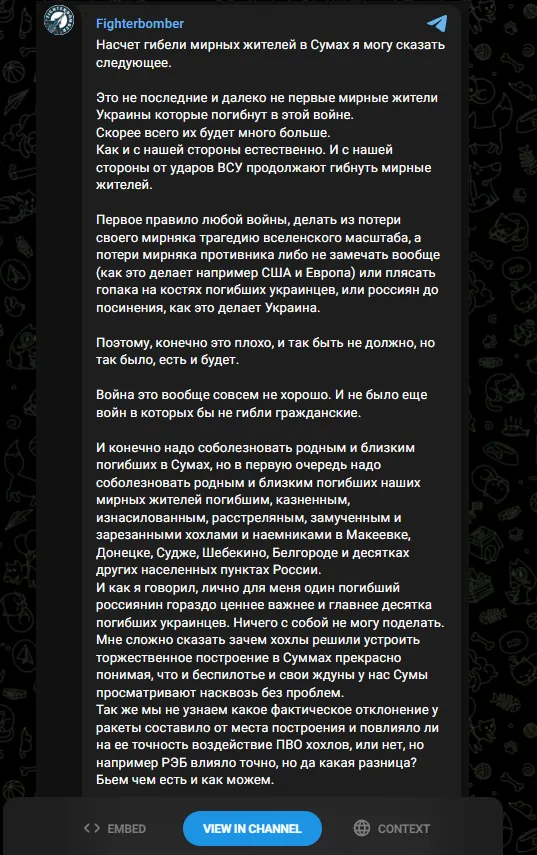
Screenshot: Fighterbomber channel, post No. 20671.
The author goes on to justify continued strikes against military targets, even when they are located in the basements of maternity hospitals, school gyms, kindergartens or hospitals. He claims that Ukraine places military facilities close to civilian sites and urges that attacks should not be called off simply because civilians are present. These are the author’s claims, not verified facts about the location of military facilities or the use of civilians as cover.
The communication technique here is the dehumanisation of the adversary and the ranking of human losses by perceived value. The deaths of Russian service members are framed in commemorative terms, while Ukrainian losses are mocked, played down or portrayed as an inevitable consequence of war. When addressing civilian deaths, the author explicitly declares that human lives are not of equal value and uses this position to justify continuing the strikes.
Discrediting Alternative Sources and Claiming the Role of an Arbiter
Fighterbomber comments on Ukrainian reports of Russian aviation losses and strikes against military facilities. Yet the channel also criticises official Russian statements whenever the author considers them inaccurate or misleading.
In post No. 16996, dated 9 June 2024, responding to reports of a strike on the airfield in Akhtubinsk and damage to a Su-57, the author accuses the Army_Russia channel of exaggerating Ukrainian losses while concealing Russia’s own. At the same time, he claims that Ukrainian users turn to unofficial Russian channels to cross-check information. In doing so, Fighterbomber presents itself as a source supposedly trusted even by the other side.
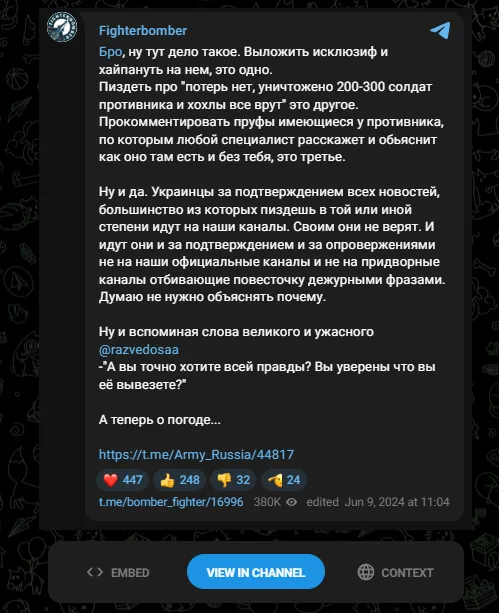
Screenshot: Fighterbomber channel, post No. 16996.
In post No. 26854, dated 15 October 2026, the author disputes Ukrainian reports that six aircraft had been hit at a Russian airfield, questions the reported number of damaged aircraft and stresses that no personnel had been lost. Yet in post No. 8157, discussing the aftermath of the strike on Novofedorivka, he acknowledges that satellite imagery can be used to assess the extent of the damage.
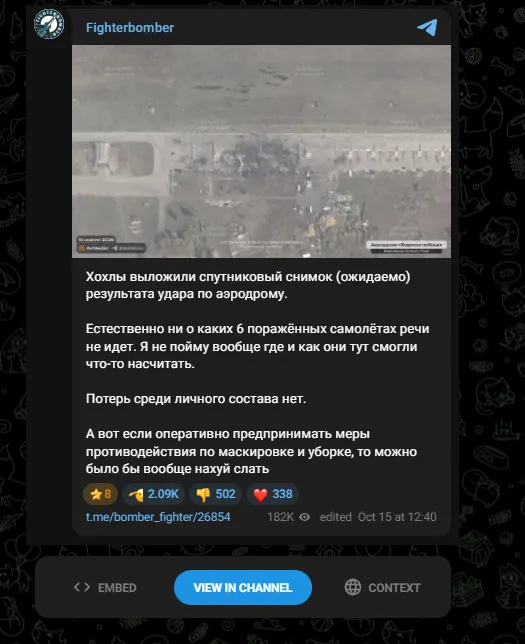
Screenshot: Fighterbomber channel, post No. 26854.
The communication technique here is to discredit competing sources while positioning oneself as an independent arbiter. The author challenges both official Russian statements and Ukrainian assessments, while presenting his own channel as a more reliable source of information. But criticising other sources does not, in itself, make his own reporting any more credible.
Discipline, Fear and the Normalisation of Combat Losses
In post No. 8824, dated 5 October 2022, Fighterbomber describes how some pilots, following the first losses suffered by Russian aviation, began to fear combat sorties, refused to carry out missions or sought transfers to other positions. The author calls for those who openly display fear and panic to be isolated, suggesting that “any means” may be used to achieve this. He also criticises the military command for failing to establish effective ways of dealing with subordinates who refuse to follow orders.
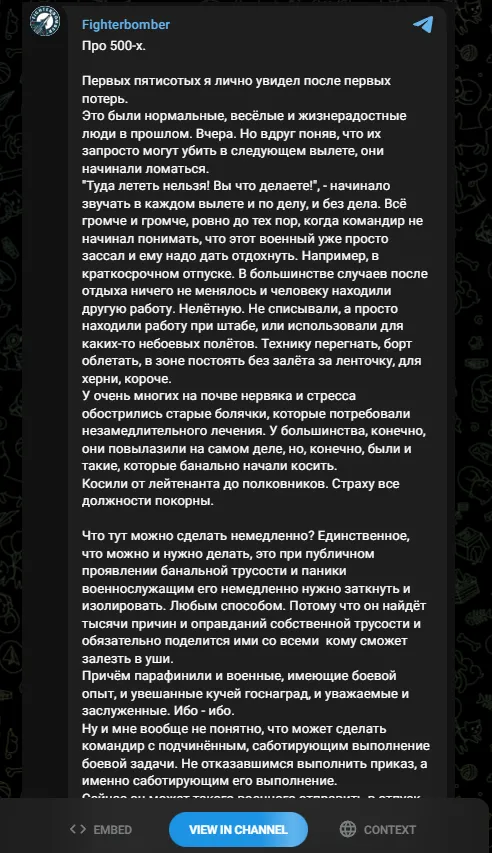
Screenshot: Fighterbomber channel, post No. 8824.
In post No. 8505, explaining how aviation and ground forces are supposed to coordinate, the author argues that once enemy positions have been destroyed, Russian infantry must move in and raise a flag. In post No. 17655, dated 6 August 2024, he comments on a Ukrainian attack and the intensity of the fighting, acknowledging that Russian aviation will continue to suffer losses.
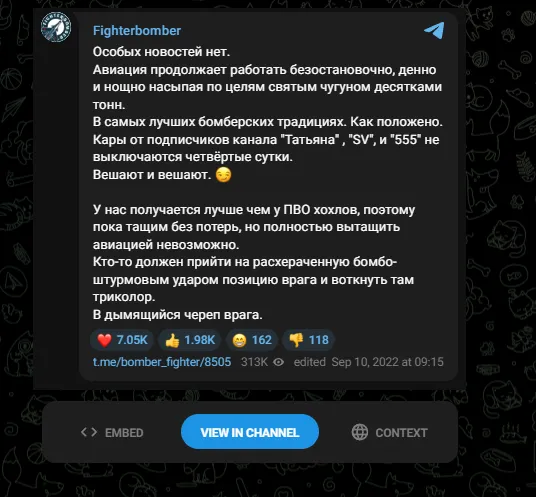
Screenshot: Fighterbomber channel, post No. 8505.
The communication technique here is the normalisation of losses and the disciplining of the audience. Fear is not treated as a natural response to the risk of being killed, but as a threat to military discipline. Losses, in turn, are presented as an ordinary part of combat operations, with no room to question whether those operations should continue.
Justifying Strikes and the Rhetoric of Escalation
In post No. 6640, Fighterbomber assesses the outcome of the first days of Russia’s full-scale invasion. The author claims that Russian strikes had destroyed a substantial part of Ukraine’s military infrastructure and that there had supposedly been no confirmed civilian casualties. He also predicts that Russia will establish control over Ukrainian airspace and that its victory is inevitable. No sources or methodology are provided to substantiate these claims.
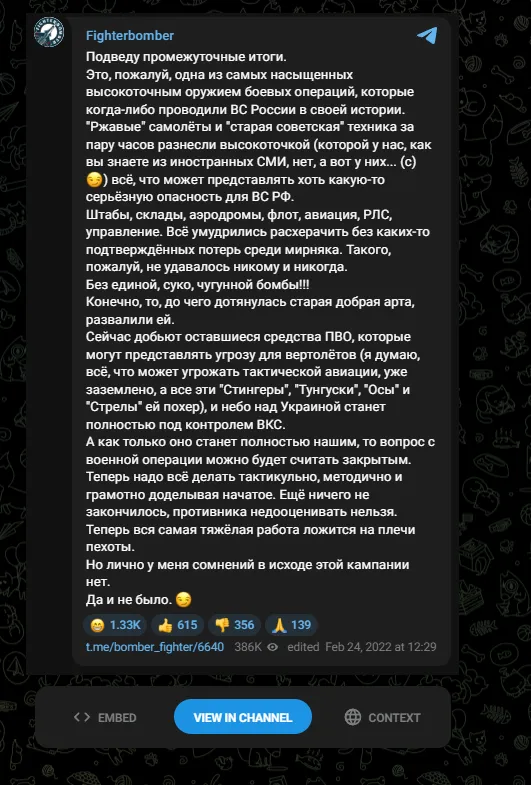
Screenshot: Fighterbomber channel, post No. 6640.
In post No. 18166, dated 21 September 2024, the author discusses Ukrainian strikes on Russian ammunition depots. He acknowledges shortcomings in the protection of these facilities, but then shifts the discussion to potential targets for further attacks. In particular, he expresses hope that Russia will launch a nuclear strike with a yield of 10–20 megatons against decision-making centres in Kyiv.
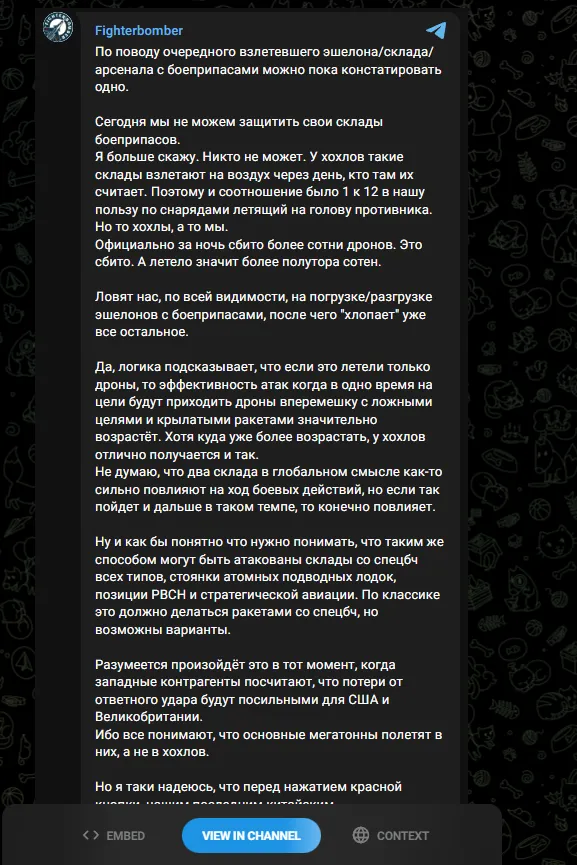
Screenshot: Fighterbomber channel, post No. 18166.
In post No. 20671, dated 14 April 2025, commenting on the civilian deaths caused by the strike on Sumy, he justifies continued attacks on targets that may be located inside civilian buildings and urges that strikes should not be called off simply because civilians are present.
The communication technique here is the normalisation of escalation and the erosion of moral restraints. Russian strikes are presented as a necessary part of the war, while the possibility of civilian casualties is treated as an acceptable consequence. The nuclear rhetoric reinforces this position, signalling a willingness to resort to the most extreme form of violence.
Normalising the Redrawing of Ukraine’s Borders
In post No. 6633, while discussing the possible consequences of Russia’s invasion for Ukraine, the author writes: “Интересно тут только какие границы будут у Новой Украины” (“The only interesting question here is what the borders of the New Ukraine will be”). He does not explain what he means by “New Ukraine”, but the wording itself implies that a change to Ukraine’s borders is a possibility.
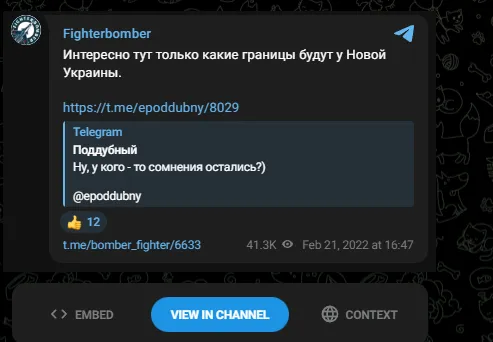
Screenshot: Fighterbomber channel, post No. 6633.
The communication technique here is the normalisation of territorial revisionism through casual phrasing. Rather than explicitly arguing for territorial claims, the author presents the prospect of changing Ukraine’s borders as an ordinary topic for discussion.
Mockery and Derogatory Language
Sarcasm and derogatory language are recurring features of Fighterbomber’s style. In post No. 7564, responding to criticism of Russian Su-34 losses, the author calls his critics “мамкины эксперты” (“armchair experts”). In post No. 8487, commenting on the situation facing Russian aviation in the Kharkiv sector, he dismisses critics as “hysterical squirrels”. In post No. 15854, published in February 2024, he refers to Ukraine as “country 404”.
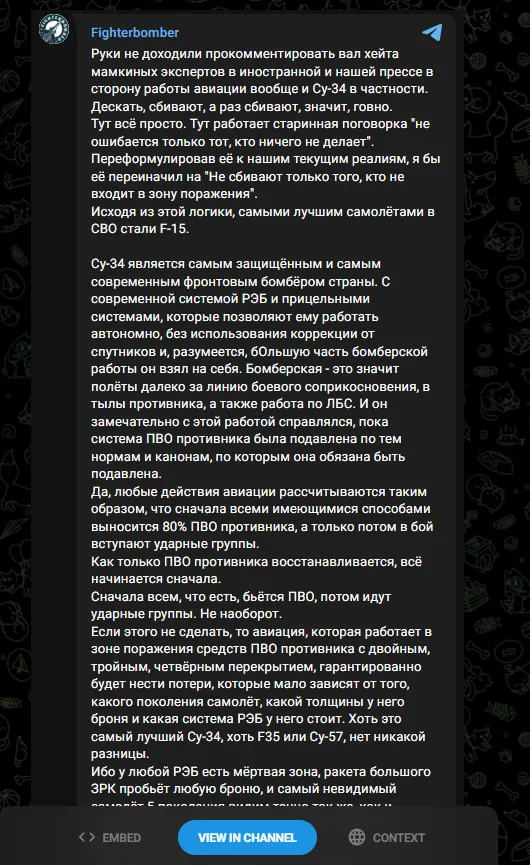
Screenshot: Fighterbomber channel, post No. 7564.
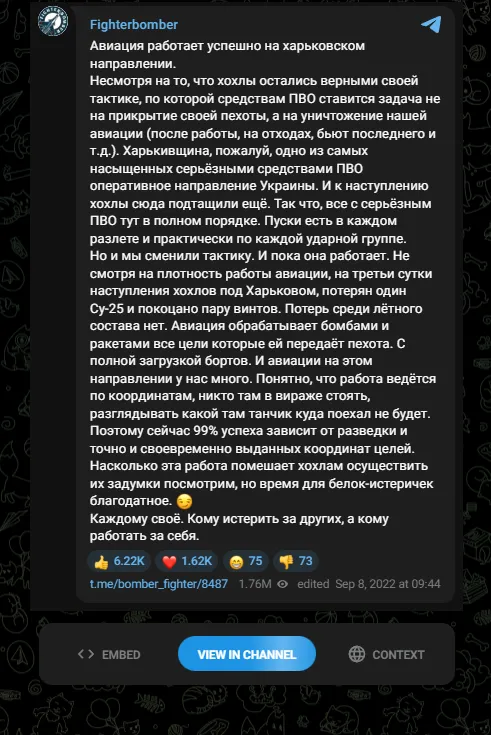
Screenshot: Fighterbomber channel, post No. 8487.
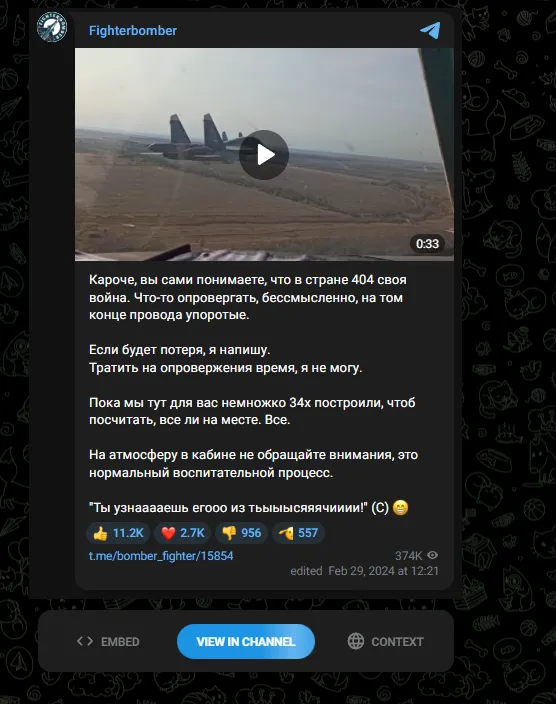
Screenshot: Fighterbomber channel, post No. 15854.
The author also uses irony to comment on setbacks suffered by his own side. In post No. 23338, dated 25 November 2025, he jokes about the destruction of the A-60 airborne laboratory aircraft in Taganrog, suggesting that the problem of disposing of an aircraft that had not been used for nearly ten years has effectively been solved.
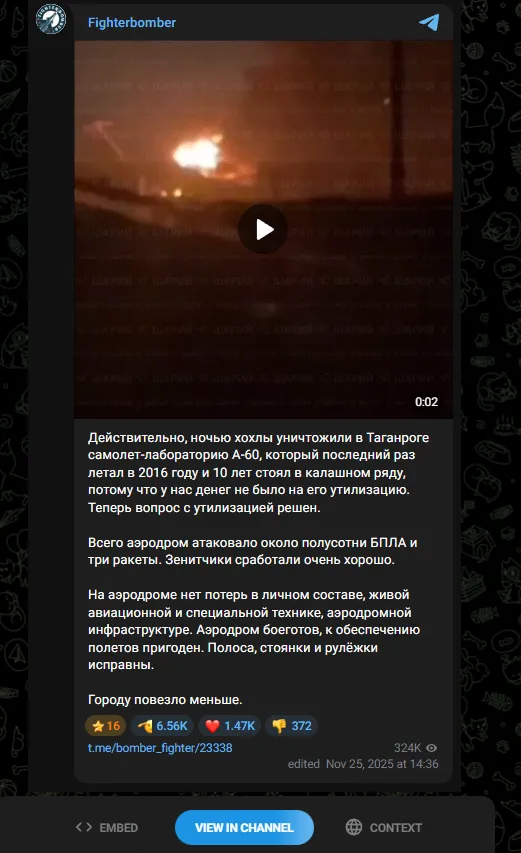
Screenshot: Fighterbomber channel, post No. 23338.
The communication technique here is to discredit through ridicule. Sarcasm allows the author to dismiss opponents without engaging with their arguments, while jokes about his own side’s losses help downplay the significance of its setbacks.
Mobilising the Audience to Support the Military
Fighterbomber cultivates an image of a community that can directly support Russian military aviation. In post No. 8505, the author mentions donations from subscribers for aviation needs. In post No. 15854, he jokes that their contributions have “built” several Su-34s.
The communication technique here is to involve the audience in both material and symbolic support for the military. Subscribers are presented not merely as consumers of information, but as participants in a shared effort, strengthening their sense of involvement in supporting the Russian armed forces.
Summary
Fighterbomber builds its authority around the image of a military professional who understands the technical aspects of warfare and supposedly knows how to distinguish the actual state of affairs from official accounts. The channel can acknowledge losses, criticise the military command, and discuss corruption and equipment failures. But this criticism has clear limits: it concerns how Russia wages the war, not why it started it.
Russian losses are explained in terms of military necessity, technical problems and command failures. Ukrainian losses become an occasion for ridicule, while civilian deaths are used to argue in favour of continuing the strikes.
What sets Fighterbomber apart is its combination of professional criticism with unwavering support for Russian aggression. The channel does not necessarily conceal problems within its own military, but treats them as obstacles to be overcome in order to wage the war more effectively, rather than as grounds for questioning the war itself.
Onufriyenko: Criticism Within the Bounds of Loyalty
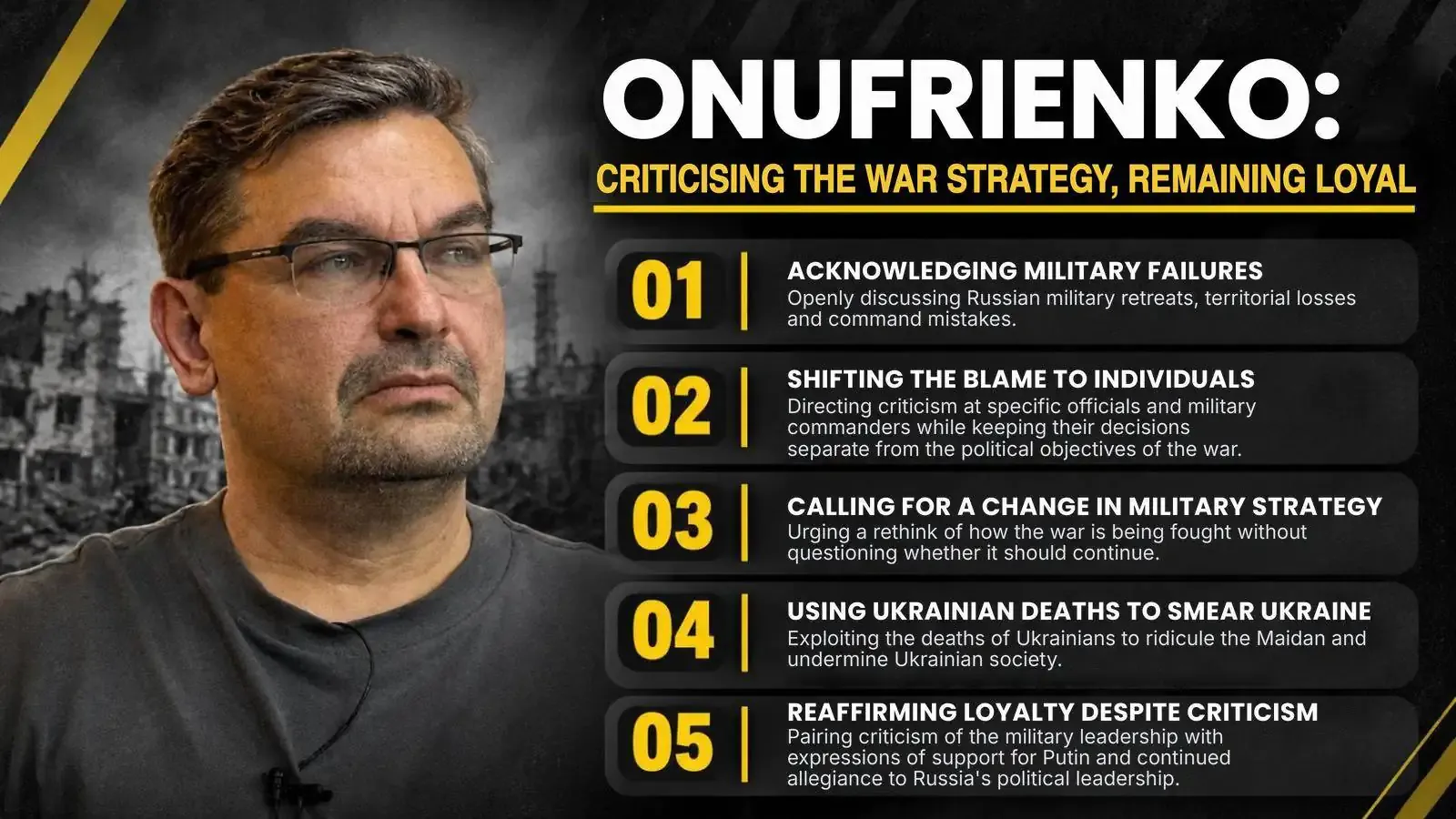
Mykhailo Onufriyenko is a blogger and military-political commentator who writes under the pseudonym “mikle1”. Although he is associated with the television channel, he is not a member of its staff. He pursued postgraduate studies, worked in securities trading during the 1990s and began commenting on politics in 2004. In 2009, he co-founded the public organisation “Great Rus”.
On 30 March 2022, the Prosecutor’s Office of the Autonomous Republic of Crimea and the city of Sevastopol opened criminal proceedings against him. YouTube removed his main channel on 3 May of the same year. According to the Centre for Investigative Journalism, he was served with a notice of suspicion in 2023, and the case was subsequently referred to court.
The “Kremlin’s Mouthpieces” register identifies Onufriyenko as a Russian propagandist, blogger, military expert and writer. It notes his support for Russian aggression against Ukraine, justification of the occupation of Ukrainian territories, calls for the establishment of separatist governing bodies in temporarily occupied territories, and endorsement of strikes against Ukraine’s critical infrastructure. The register also cites examples of his rhetoric: he refers to Ukrainian service members as “enemy meat”, describes the Revolution of Dignity as a “coup” and calls the Ukrainian government a “junta”.
Profile on Myrotvorets: accused of knowingly crossing Ukraine’s state border through closed border checkpoints, promoting separatism online, and expressing anti-Ukrainian sentiment. These characterisations should be understood specifically as the position of the authors of the relevant database.
Unlike commentators who consistently deny or downplay Russian setbacks, Onufriyenko is willing to discuss them openly. He speaks about retreats, command failures, strategic miscalculations and shortcomings in Russian media coverage. Yet his criticism has a clear boundary: he questions how the war is being fought, not the political objectives behind it.
His commentary on the war illustrates this distinction. By late 2022, judging by his interview with Ukraina.ru about Siversk, he was portraying the setbacks as affecting only the Ukrainian Armed Forces. On 23 August 2023, following Prigozhin’s mutiny, he released a video titled “Surovikin, Kherson, Prigozhin’s Mutiny”, subtitled “Punishing the Innocent and Rewarding Those Who Had Nothing to Do with It”. Both examples point to his willingness to address problems within Russia’s military and political leadership. They do not, however, indicate any departure from his overall pro-war position.
On 17 August 2024, Onufriyenko described the events in the Kursk region as a purely political decision by Kyiv. In April 2026, he mocked what he called the “Leopold the Cat syndrome” among Russia’s leadership. Then, in an interview with Ukraina.ru on 1 October 2026, he acknowledged that Russian forces had retreated in the Lyman sector. He argued that “we need to change our strategy”, blamed Shoigu’s “fire barrage” approach for prolonging the war and criticised what he called the “unhealthy reaction of our media”.
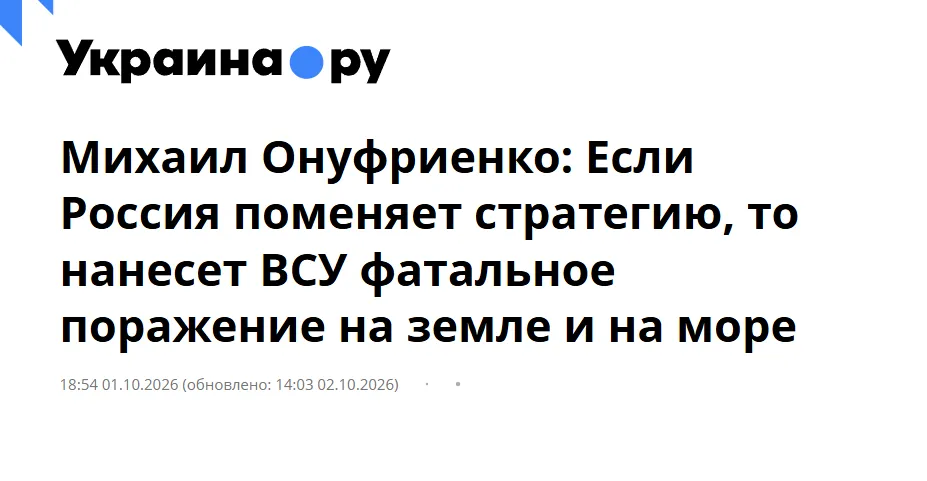
Screenshot: Headline of the Ukraina.ru interview, 1 October 2026.
Criticism of the Strategy, Not the War Itself
Onufriyenko is considerably more outspoken about problems within the Russian military than commentators who portray every setback as insignificant or dismiss it as enemy exaggeration. He acknowledges retreats, challenges command decisions, points to mistakes by the political leadership and questions how Russian media report events.
The key issue is what his criticism actually challenges. He questions the way Russia is conducting the war, why its chosen strategy is failing to deliver the expected results and what needs to change. But he does not question Russia’s aggression against Ukraine or the objectives it seeks to achieve. His criticism is directed at the effectiveness of military and political decisions, not at the decision to launch the invasion.
This distinction allows him to present himself as a critical commentator while remaining firmly within the pro-war camp. Acknowledging mistakes does not undermine his loyalty. Instead, it can be framed as a necessary step towards correcting those mistakes and continuing the war more effectively.
Selective Candour and the Shifting of Responsibility
Onufriyenko’s criticism tends to have clearly defined targets: military commanders, individual officials, specific political decisions or media outlets whose response to events he considers inadequate. This allows him to acknowledge serious problems without questioning the system as a whole.
His assessment of Shoigu’s “fire barrage” strategy as one of the reasons the war has dragged on is a telling example. Responsibility is placed on a particular military approach, rather than on the underlying logic of Russian aggression. Similarly, his criticism of the “unhealthy reaction of our media” shifts attention to the way events are reported, rather than to the political responsibility behind them.
The result is a narrative that offers explanations for Russia’s setbacks without suggesting that its policy towards Ukraine should be reconsidered. Candour remains selective: failures can be discussed, provided they are attributed to individual decisions, poor management or strategic mistakes, and do not call the overall objectives into question.
Russian and Ukrainian Losses: A Double Standard
A post about the strike on Feodosia illustrates how this approach works when Russian losses are involved. Onufriyenko acknowledges the damage: windows were shattered, the port and railway station were affected, the large landing ship Novocherkassk was damaged and one person was killed. At the same time, he immediately labels the attack an act of terrorism.
He does not publish footage from the scene, explaining that doing so is “the sort of thing dishonest bloggers do”. He then plays down the strike’s military significance, writing that it will not bring back Marinka or cancel half a million draft notices and will therefore “have no impact whatsoever on the course of the war”. The focus then shifts to future Ukrainian casualties: he claims that Ukrainians will “jump around a little before their own government sends them off to be slaughtered”.
Several techniques are at work here. Onufriyenko acknowledges Russian losses but immediately frames the attack as terrorism and minimises its military consequences. He then redirects attention towards supposedly inevitable Ukrainian casualties. Notably, in this post, the word “meat” refers specifically to Ukrainians, not Russian service members.
Based on the events described, the post appears to date from late December 2023, although the screenshot does not show a publication date.
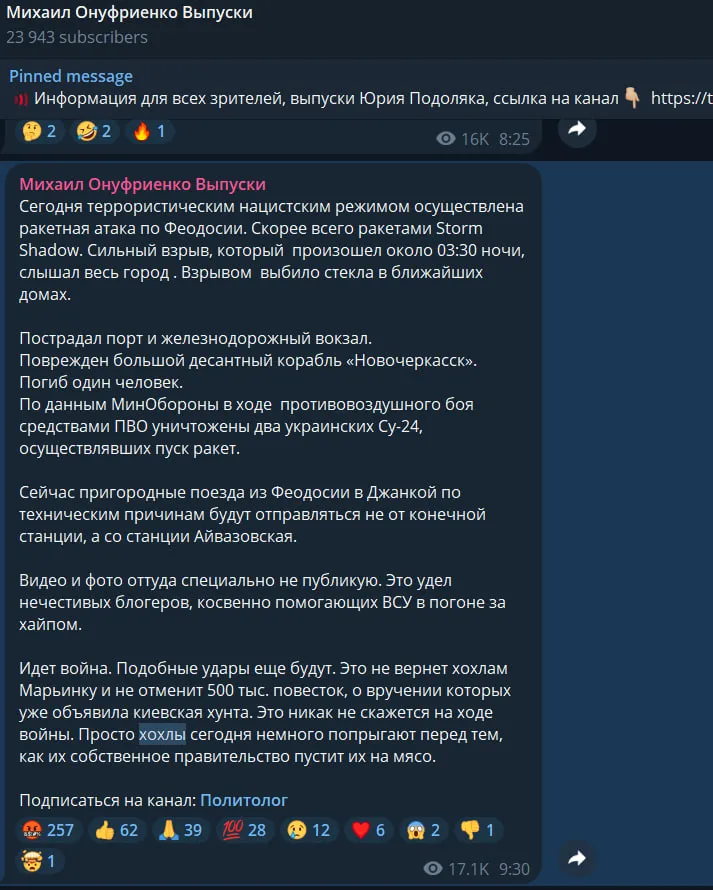
Screenshot: “Mikhail Onufriyenko Releases” channel, post about the strike on Feodosia.
The double standard becomes even more apparent in a post about a funeral in Liubotyn, Kharkiv region. On 17 August 2023, Onufriyenko published a video of the funeral procession, commenting that it seemed to include “the entire surviving population”. He ended the post with the question: “How do you like the Maidan?”
Here, the deaths of Ukrainians become an occasion for mockery and political derision. Russian losses are framed in terms of terrorism, military necessity and the wider course of the war. Ukrainian losses, by contrast, are used to ridicule the adversary and discredit the Revolution of Dignity.
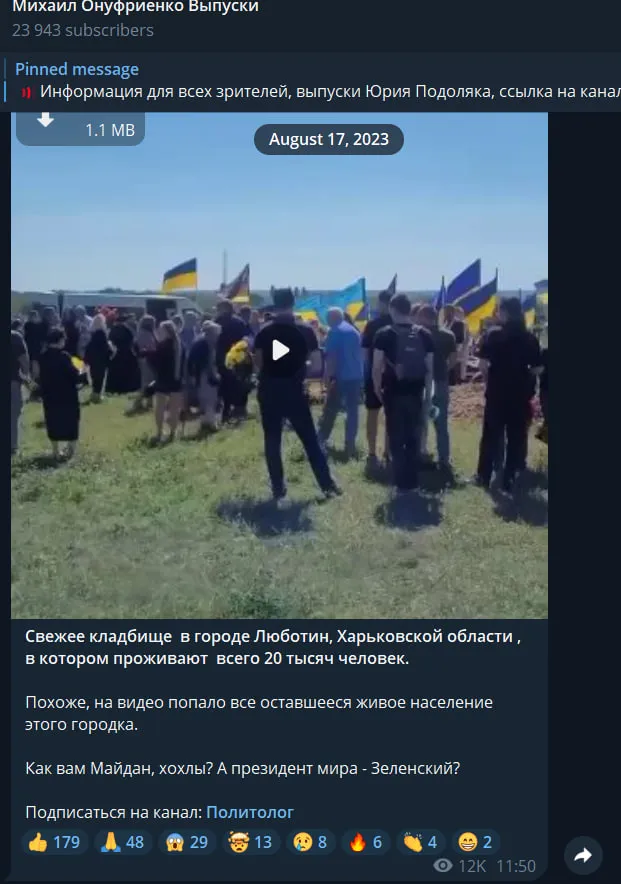
Screenshot: “Mikhail Onufriyenko Releases” channel, 17 August 2023.
Loyalty as the Ultimate Boundary
The clearest illustration of the limits of Onufriyenko’s criticism is the contrast between his harsh assessments of Russia’s military strategy and a post published on 27 October 2026 under the title “Pray to Putin”. Even as he acknowledges retreats, command failures and the prolonged course of the war, he publicly reaffirms his loyalty to the Russian president.
The contrast is telling. His criticism of military decisions does not extend to challenging the political leadership itself. Onufriyenko can call for a change of strategy, condemn decisions made by Shoigu and criticise Russian media for their response to setbacks, while at the same time urging his audience to “pray to Putin”.
His critical stance should therefore not be mistaken for a distancing from Russian policy or a reassessment of his position on the war. It is criticism of the way the war is being conducted, voiced by someone who remains firmly aligned with Russia’s political leadership.
What distinguishes Onufriyenko from the other commentators examined in this study is the degree of openness with which he discusses Russia’s military problems. He goes beyond acknowledging individual losses: he openly calls for a change of strategy and criticises decisions that prolong the war. Yet his candour never extends beyond the limits of loyalty to Putin and support for Russian aggression. He challenges the way the war is being fought, but never the reasons Russia started it.
Concluding Remarks
The way Russian war correspondents and media commentators talk about military setbacks and losses is not a haphazard collection of reactions. It is a set of recurring rhetorical techniques that took shape between 2022 and 2026. Dolgachev shifts failures onto the enemy and portrays Russia’s own losses as acceptable. Yegortsev interprets them through a religious lens, although on his personal channel he acknowledges retreats and limits his questions to procedural matters, such as the formal recognition of missing service members as dead. Vorsobin voices concerns through other people’s accounts, poses rhetorical questions and criticises the way the war is being conducted without questioning its objectives. Fighterbomber relays other people’s harsh assessments and criticises specific failures. Onufriyenko questions the strategy while remaining loyal to Putin. In terms of candour, these approaches form a spectrum, ranging from Dolgachev’s refusal to acknowledge Russian setbacks in his own rhetoric to Onufriyenko’s open criticism of military decisions.
The dividing line between acceptable and unacceptable criticism does not run between loyalists and critics. It lies between two questions: “How?” and “Why?” The conduct of the war, military strategy and accountability for losses can all be discussed. The objectives of the war cannot. None of the five criticises Putin in their own voice. The sole exception is a post by Vorsobin dated 1 March 2022, in which he asks what the war is being fought for. In his later commentary, that question largely disappears, surviving, at most, in rhetorical remarks.
Within this system, criticism serves a clear purpose: it allows commentators to speak openly about the war without calling its objectives into question. The sample is small and manually selected, so the findings illustrate a recurring pattern rather than prove that it is universal.
Sources:
https://smotrim.ru/person/242526
https://war-sanctions.gur.gov.ua/en/propaganda/persons/23084
https://t.me/s/Dolg_z
https://ok.ru/group/70000036517926/topic/157296084421926
https://osintflow.com/news/diti-yak-rekvizit-propagandi/
https://ru.wikipedia.org/wiki/Егорцев,_Александр_Юрьевич
https://rg.ru/2022/11/17/vo-vremia-molitvy-russkih-soldat-proizoshlo-chudo-zamirotochila-ikona-bogorodicy.html
https://t.me/s/spastv?before=21715
https://ircity.ru/text/incidents/2023/10/23/72839411/
https://spastv.ru/aleksandr-egortsev-zhurnalist-v-okopah-chudesa-donetskoj-ikony-molitva-russkogo-soldata-russkij-kovcheg/
https://radiokp.ru/podcast/grazhdanskaya-oborona/578265
https://radiokp.ru/podcast/grazhdanskaya-oborona/655381
https://politnavigator.news/krymchane-boyatsya-odnogo-chtoby-ruka-moskvy-ne-zadrozhala-vorsobin.html
https://t.me/s/bomber_fighter?before=25649
https://focus.ua/voennye-novosti/570661-ukrainskie-osint-analitiki-ustanovili-avtora-rossiyskogo-kanala-fighterbomber-foto
https://tgwars.sirena.news/
https://war-sanctions.gur.gov.ua/en/propaganda/persons/36637
https://www.svoboda.org/a/samaya-lakomaya-tselj-rossiya-poteryala-unikaljnyy-samolet/32775281.html
https://focus.ua/voennye-novosti/672988-mog-li-ukrainskiy-f-16-sbit-rossiyskiy-su-34-kotoryy-sbrasyval-kaby-ekspert-dal-obyasnenie-video
https://rutube.ru/video/5b6e3b548c564d8144bd7196dbb0eabf/
https://belta.by/special/society/view/onufrienko-ob-atakah-vsu-na-kurskuju-oblast-publichnye-eskapady-dlja-kieva-vazhnee-situatsii-na-fronte-654823-2024/
https://ukraina.ru/20261001/mikhail-onufrienko-esli-rossiya-pomenyaet-strategiyu-to-naneset-vsu-fatalnoe-porazhenie-na-zemle-i-na-1083544137.html
https://t.me/onufrienko
https://myrotvorets.center/criminal/dolgachev-nikolaj-valerevich/
https://fedpress.ru/person/3292303
https://myrotvorets.center/criminal/vorsobyn-vladymyr-vladymyrovych/
https://ru.wikipedia.org/wiki/Ворсобин,_Владимир_Владимирович
https://rutube.ru/video/d6edf676388fe462dc49a5f8598bdc49/
https://war-sanctions.gur.gov.ua/en/propaganda/persons/36254
https://myrotvorets.center/criminal/onufryenko-mykhayl-borysovych/
https://myrotvorets.center/criminal/tumanov-ylia-borysovych/
https://www.dialog.ua/russia/327141_1768480773
https://osintflow.com/news/vorsobin-volodimir-volodimirovich/
https://osintflow.com/news/egortsev-alexander-yuryevich/
https://myrotvorets.center/criminal/ehortsev-aleksandr-yurevych/